
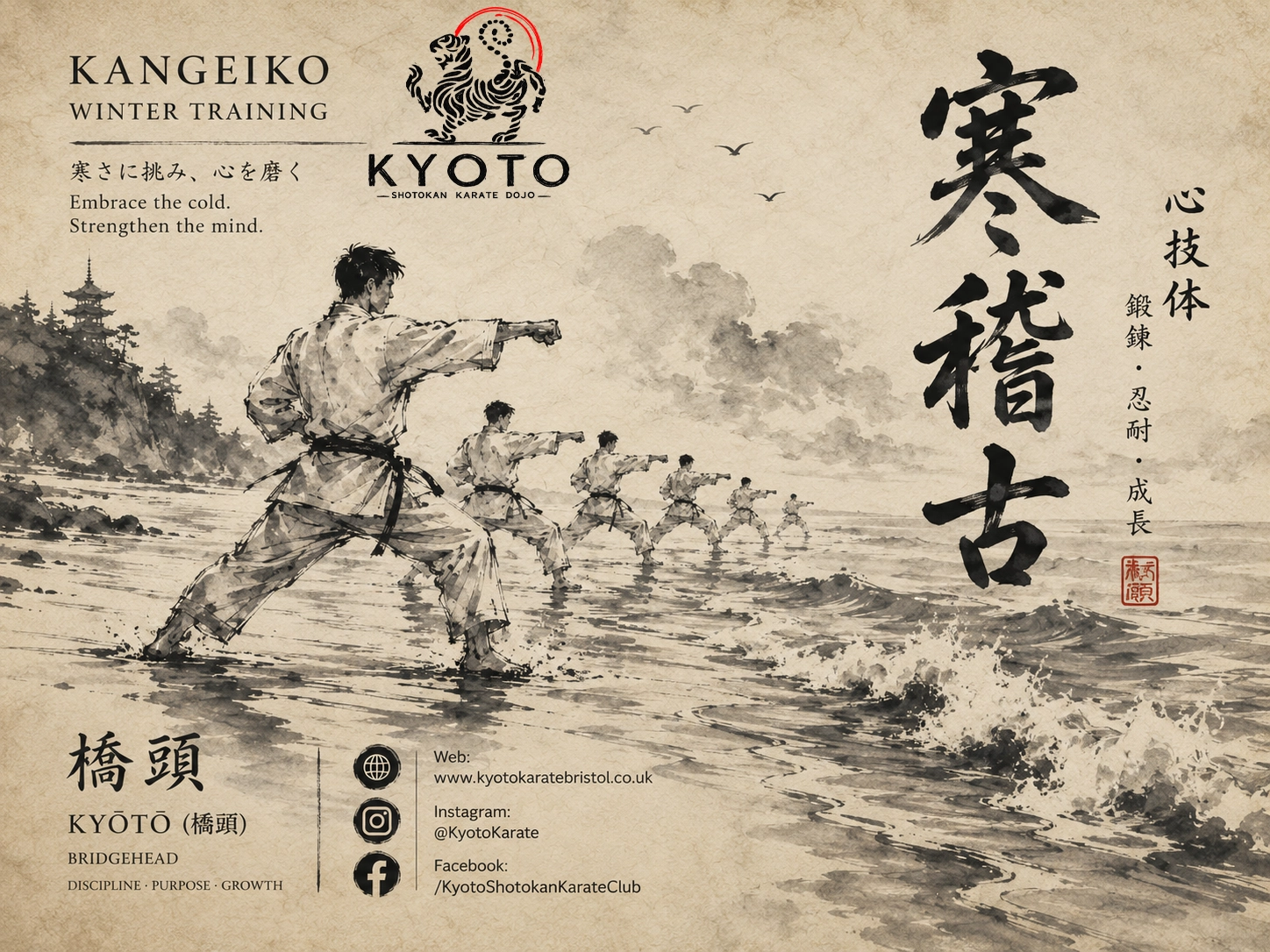
 Earlier this year, members of Kyōtō Shotokan Karate Dojo travelled to the Lincolnshire coast to take part in Kangeiko training on Cleethorpes beach (read more about that Kangeiko visit) — a traditional form of winter martial arts practice rooted deeply within Japanese budō culture.
But what exactly is Kangeiko?
Why would karate practitioners willingly train outdoors in freezing temperatures, icy winds and dark winter mornings?
And does this old tradition still hold value in modern karate?
What Does “Kangeiko” Mean?
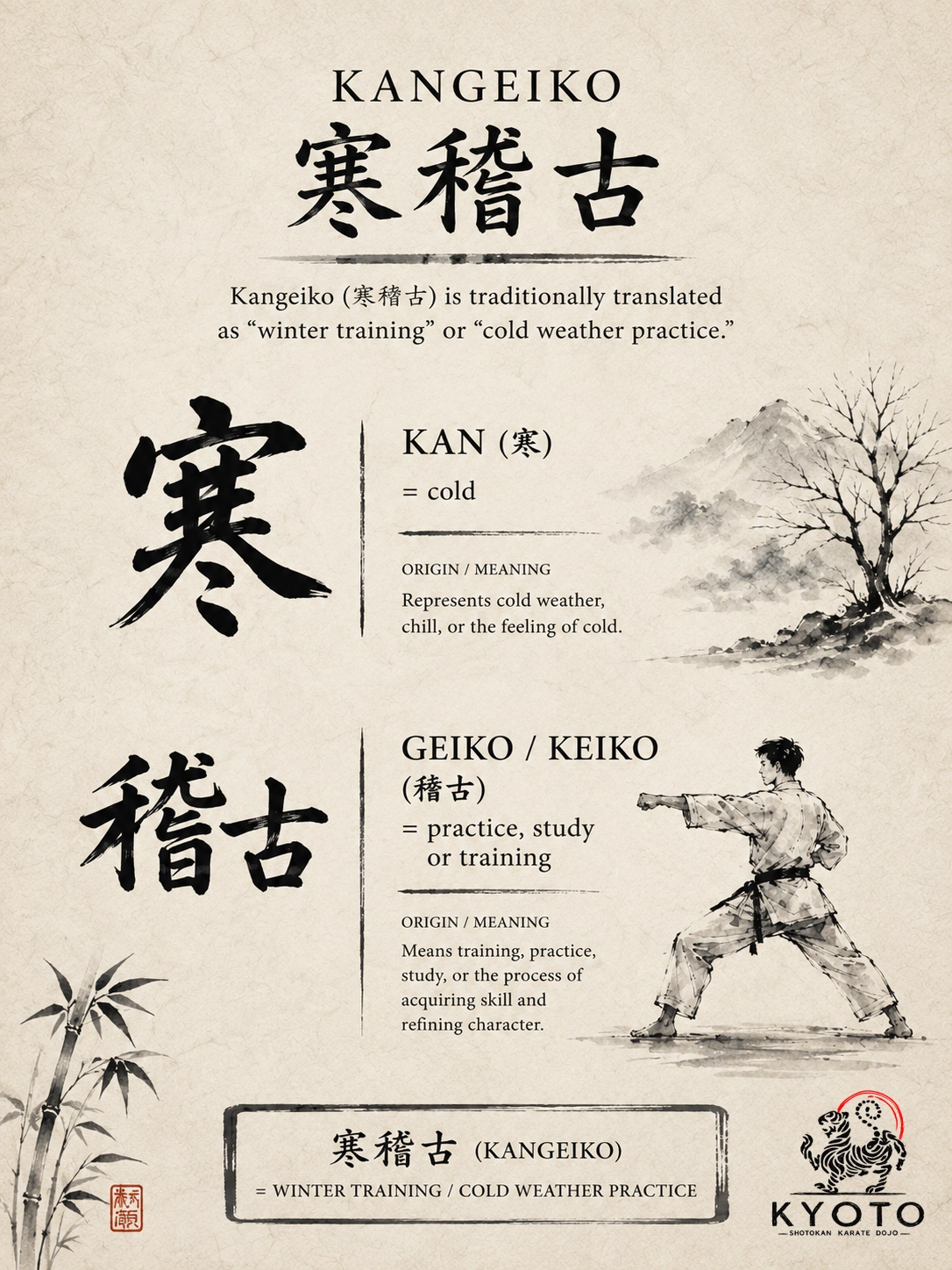 Kangeiko (寒稽古) is traditionally translated as “winter training” or “cold weather practice.”
- Kan (寒) = cold
- Geiko / Keiko (稽古) = practice, study or training
The term has long-standing roots within Japanese martial traditions, particularly within karate, judo, kendo and other budō arts.
Historically, martial artists would train during the harshest periods of winter — often before sunrise — as a way of developing not only physical endurance, but also discipline, spirit and mental resilience.
In many ways, Kangeiko reflects one of the deeper principles of traditional karate:
training the character as much as the body.
The History of Kangeiko
Kangeiko has origins stretching back centuries within Japanese martial culture.
Traditional martial schools often believed that difficult environmental conditions sharpened concentration and forged stronger spirit. Winter training became associated with austerity, perseverance and self-discipline.
In older Japanese society, there was also a cultural appreciation for enduring hardship voluntarily in pursuit of self-improvement — a concept that still appears throughout budō training today.
Historically, Kangeiko could involve:
- Early morning training before dawn
- Outdoor kihon practice in freezing weather
- Running drills
- Kata repetition
- Meditation and breathing exercises
- Water purification practices (misogi)
- Training barefoot outdoors
- Extended repetitive basics to test focus and spirit
While some historical examples could be extreme, the core purpose was rarely about suffering for its own sake.
Instead, the challenge was intended to strip away comfort and distraction, forcing practitioners to rely on discipline, mindset and determination.
What Does Kangeiko Consist Of?
 Modern Kangeiko varies between clubs and organisations.
Some dojo hold week-long winter courses, while others organise single outdoor training sessions during the coldest part of the year.
A typical karate Kangeiko session may include:
- Warm-up and mobility work
- Kihon basics
- Kata practice
- Kumite drills
- Running exercises
- Beach or outdoor conditioning
- Group spirit training
- Meditation or mokusō
- Sunrise training sessions
At the recent Cleethorpes beach session attended by members of Kyōtō, training included kihon practice directly on the winter shoreline, with the cold wind, uneven sand and winter conditions all becoming part of the experience itself.
Unlike a heated dojo floor, outdoor winter training introduces unpredictability and discomfort — forcing karateka to adapt both physically and mentally.
Why Do Kangeiko?
To an outsider, Kangeiko can seem unusual.
Why deliberately train in the cold?
The answer lies partly in what traditional karate was always intended to develop.
Kangeiko is not primarily about fitness, toughness or proving superiority.
It is about confronting discomfort voluntarily.
Modern life is increasingly built around convenience, comfort and avoidance of hardship. Traditional budō often moves in the opposite direction — deliberately exposing practitioners to challenge in controlled and meaningful ways.
Kangeiko can help develop:
- Mental resilience
- Discipline
- Perseverance
- Focus under stress
- Group spirit and camaraderie
- Appreciation for ordinary training conditions
- Connection to traditional martial culture
There is also something psychologically powerful about shared hardship.
Training together outdoors in winter conditions often creates a strong sense of unity and mutual encouragement that differs from regular dojo practice.
Many karateka remember Kangeiko sessions for decades afterwards — not because they were enjoyable in the conventional sense, but because they were memorable, formative experiences.
When and Where Does Kangeiko Take Place?
Traditionally, Kangeiko is held during the coldest period of winter, often in January or early February.
Sessions may take place:
- On beaches
- In parks or open countryside
- At shrines or temples
- In unheated dojo
- At special winter seminars
- During residential martial arts courses
Beach training has become particularly associated with Kangeiko because of the symbolic and physical challenge of the environment:
- freezing wind,
- unstable footing,
- cold sea air,
- and exposure to the elements.
For many karateka, sunrise beach training has become one of the most iconic images of winter martial arts practice.
Kangeiko in Modern Traditional Karate
In modern karate, opinions on Kangeiko vary.
Some view it as an important connection to traditional budō values and martial spirit.
Others see it as symbolic rather than essential.
But even in contemporary dojo culture, Kangeiko still offers something increasingly rare:
an opportunity to step outside normal routines and experience karate differently.
Traditional karate was never intended to exist purely within comfortable sports halls.
Practices like Kangeiko remind us that karate is not only about grading syllabuses, competition medals or technical precision.
It is also about mindset, perseverance and personal growth.
Within organisations such as Shotokan Karate International Federation, many instructors continue to preserve traditions like Kangeiko because they reinforce the deeper educational and philosophical aspects of karate training.
For Kyōtō, events like winter beach training also connect strongly with the dojo’s wider 橋頭 (Kyōtō / Bridgehead) philosophy — the idea of stepping beyond comfort zones and crossing from where we are now toward future development.
Sometimes that bridge begins in the cold, standing barefoot on winter sand before sunrise.
And sometimes those are the training sessions remembered longest.