
Why traditional karate begins by following before understanding
🧭 The next stage in the Kyōtō Pathway
After foundations are built through Kihon, and progress begins through Kaizen, the next stage in the Kyōtō Pathway is:
守 (Shu)
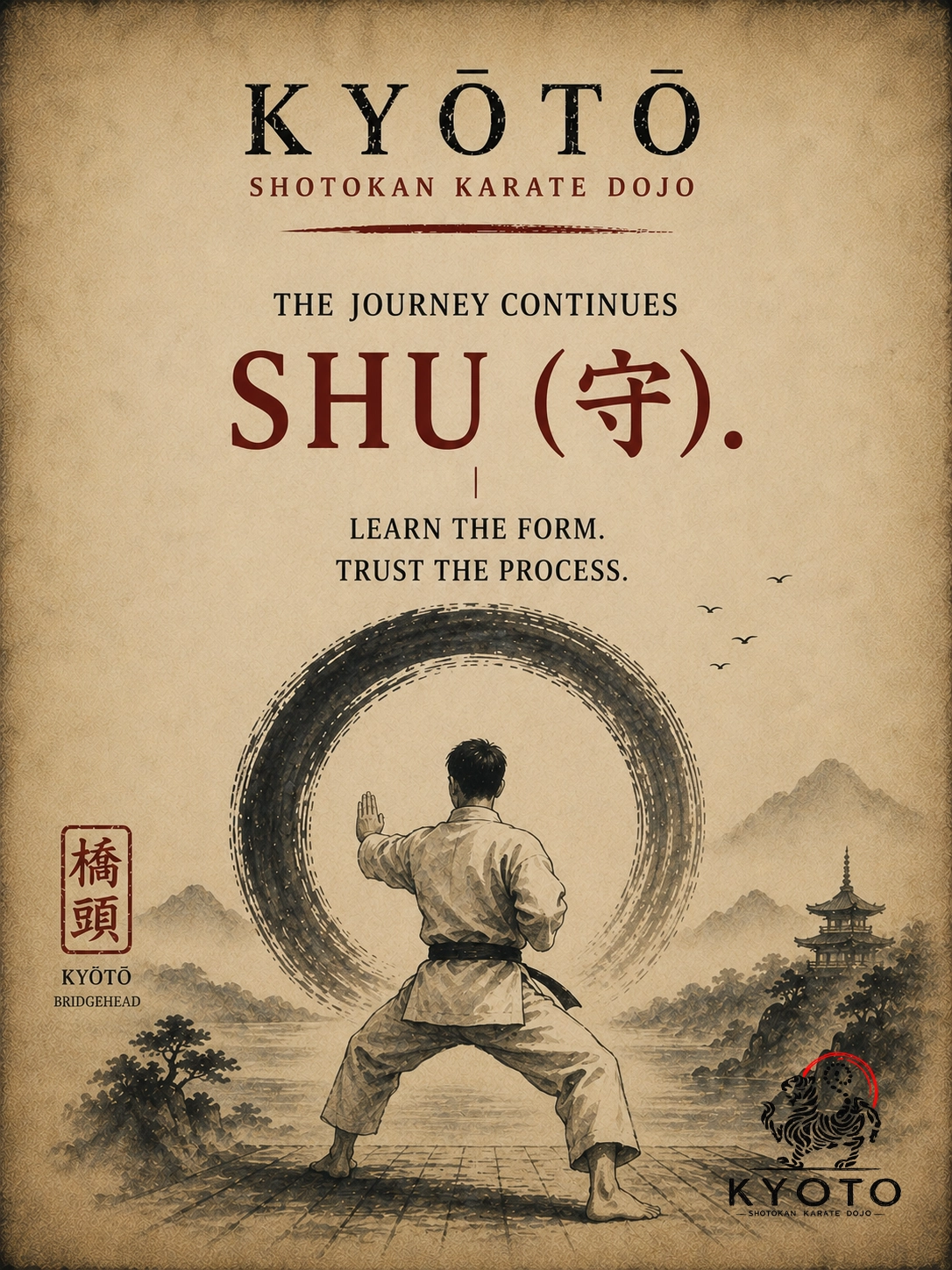 To protect. To follow. To preserve.
In traditional Japanese martial arts, Shu represents the stage where the student learns by following the form exactly.
At first, this can feel restrictive.
Why repeat movements in a precise way?
Why focus so heavily on details?
Why not just “make it work” naturally?
Because before a structure can be adapted…
it must first be understood.
🥋 Trusting the process
In modern culture, there is often pressure to personalise everything immediately.
To find your own style.
To move quickly.
To skip ahead.
But Shu teaches something different.
It asks the student to:
- Observe carefully
- Repeat accurately
- Trust the structure
- Follow the process
Not forever—but long enough for the foundations to become stable.
🌉 Learning to cross the bridge
Imagine standing at the beginning of a bridge crossing.
At first, you don’t yet understand its full structure.
You trust the path laid before you.
Step by step, you learn:
- Where to place your feet
- How the bridge moves
- How balance is maintained
Only later do you begin to understand why it was built this way.
Karate follows the same principle.
Before freedom comes structure.
🧠 Why repetition matters
At the Shu stage, repetition is not about copying mindlessly.
It is about building correct habits deeply enough that they become natural.
A student may not fully understand a correction at first.
But over time:
- posture improves
- movement becomes cleaner
- timing becomes sharper
- unnecessary tension disappears
What once felt forced begins to feel natural.
⚖️ The mistake many people make
One of the biggest obstacles in training is trying to personalise techniques too early.
Before understanding structure, adaptation often becomes inconsistency.
Traditional karate avoids this by first teaching:
- correct form
- correct distance
- correct movement
- correct timing
Only once these become stable can deeper understanding emerge.
First learn the form. Then begin to understand it.
🌱 Shu is not limitation
From the outside, Shu can appear rigid.
But in reality, it creates freedom later.
Because once strong structure exists, the student is no longer relying on guesswork.
They have something stable to build from.
At Kyōtō, we do not see this stage as restriction.
We see it as preparation.
🌉 Part of the Kyōtō Pathway
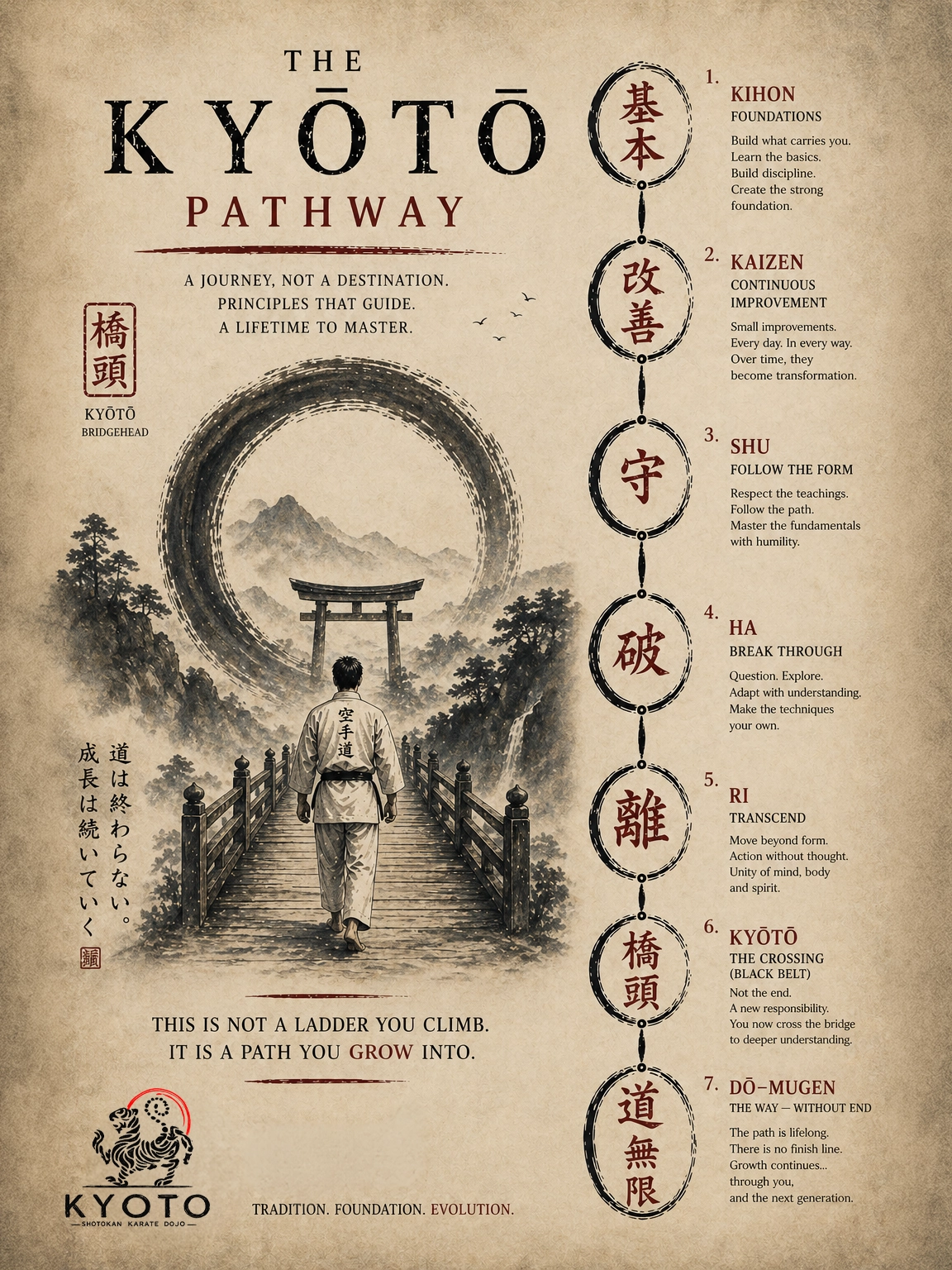 Shu is the third stage in the Kyōtō Pathway:
- Foundations (Kihon)
- Continuous Improvement (Kaizen)
- Learning the Form (Shu)
- Understanding the Form (Ha)
- Transcending the Form (Ri)
- Crossing (Kyōtō / Black Belt)
- The Endless Path (Dō–Mugen)
Each stage builds on the last.
🔗 Continue the journey
👉 Next: Ha (破) — beginning to break and understand the form
📍 Train with Kyōtō
If you’re looking to begin karate—or continue your training with a traditional approach focused on long-term development—you can learn more here:
👉 https://www.kyotokaratebristol.co.uk/about/shotokan
👉 https://www.kyotokaratebristol.co.uk/join-our-karate-classes
📍 Based in Bristol (BS11)
🥋 Beginners welcome
👨👩👧👦 Family-friendly classes