
When understanding begins to emerge in traditional karate
🧭 The next step in the Kyōtō Pathway
After building foundations through Kihon, developing consistency through Kaizen, and learning structure through Shu, the next stage in the Kyōtō Pathway is:
破 (Ha)
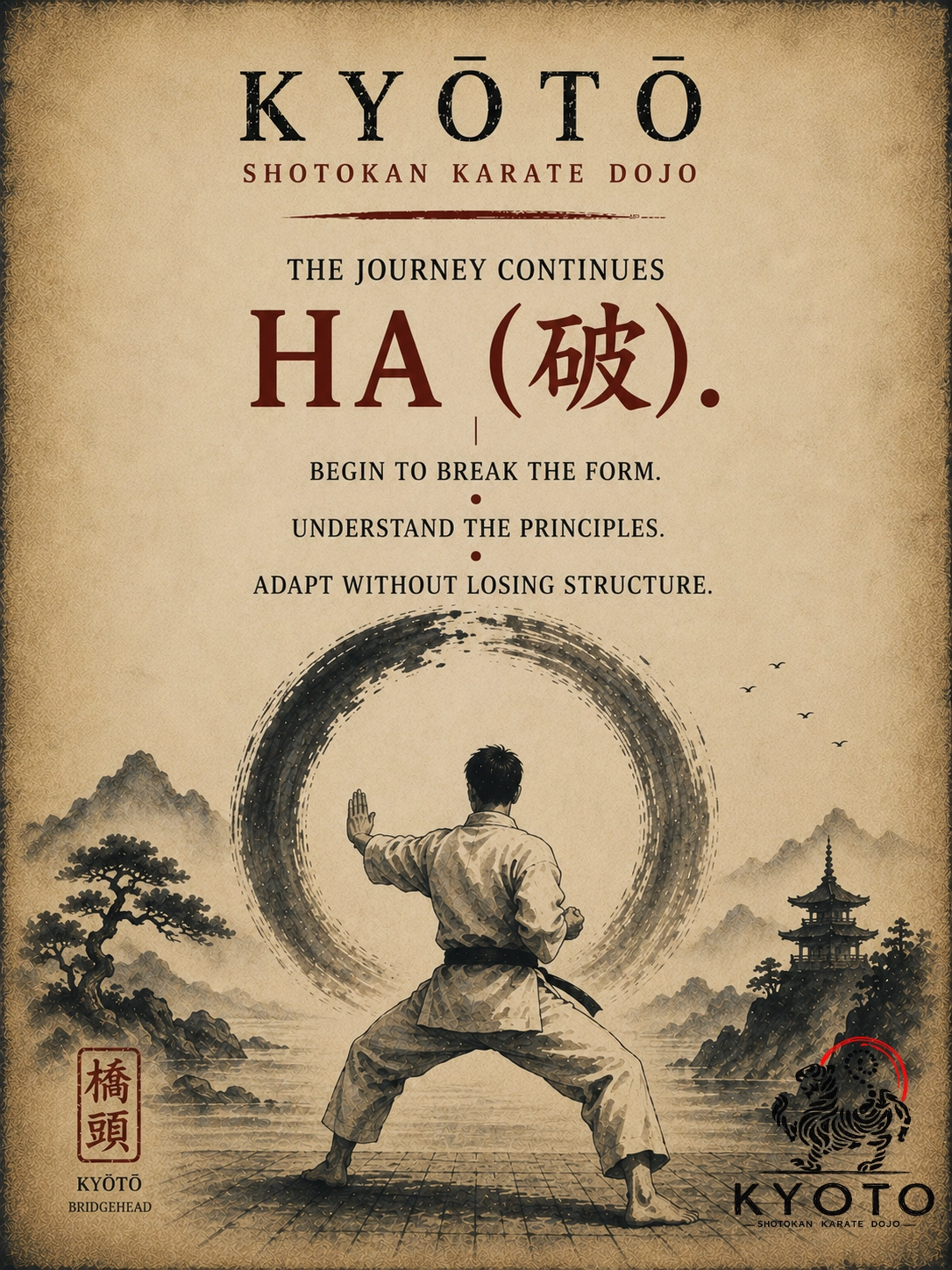 To break. To separate. To begin to understand beyond the form.
At first glance, the word “break” can sound destructive.
But in traditional martial arts, Ha does not mean abandoning the fundamentals.
It means beginning to understand them deeply enough to move beyond simple imitation.
🥋 From copying… to understanding
During the Shu stage, students learn by following the form carefully.
Movements are repeated precisely.
Corrections are followed closely.
Structure is preserved.
But eventually, something begins to change.
The student starts to understand:
- why a stance works
- why distance matters
- why timing changes a technique
- why subtle adjustments affect balance and power
This is the beginning of Ha.
🌉 Understanding the structure beneath the bridge
Imagine crossing a bridge you have trained on for years.
At first, you simply trusted the path.
Now, you begin to understand:
- how the structure distributes weight
- why certain supports exist
- how flexibility prevents collapse
- how the bridge adapts to pressure
The bridge itself has not changed.
Your understanding of it has.
Karate follows the same principle.
🧠 Adaptation without losing structure
Ha is often misunderstood.
It is not:
- ignoring basics
- inventing techniques randomly
- rejecting traditional practice
True Ha still remains connected to strong foundations.
The difference is that movements are no longer performed only because they were taught…
They begin to make sense internally.
The student starts adapting naturally:
- adjusting distance instinctively
- changing timing fluidly
- applying principles rather than memorising sequences
⚖️ Why this stage matters
Without Ha, karate can become mechanical.
But without Shu before it, adaptation becomes unstable.
Traditional training follows this progression carefully:
- Learn the structure
- Understand the structure
- Then begin to move beyond it
Freedom without foundations becomes chaos. Foundations without growth become rigidity.
Ha exists between the two.
🌱 The beginning of individuality
This is often the stage where karate starts to feel more personal.
Not because students are “doing their own thing”…
But because they are beginning to understand principles rather than simply copying movements.
Two karateka may perform the same technique differently—yet both remain structurally correct.
This is where understanding begins to emerge.
🌉 Part of the Kyōtō Pathway
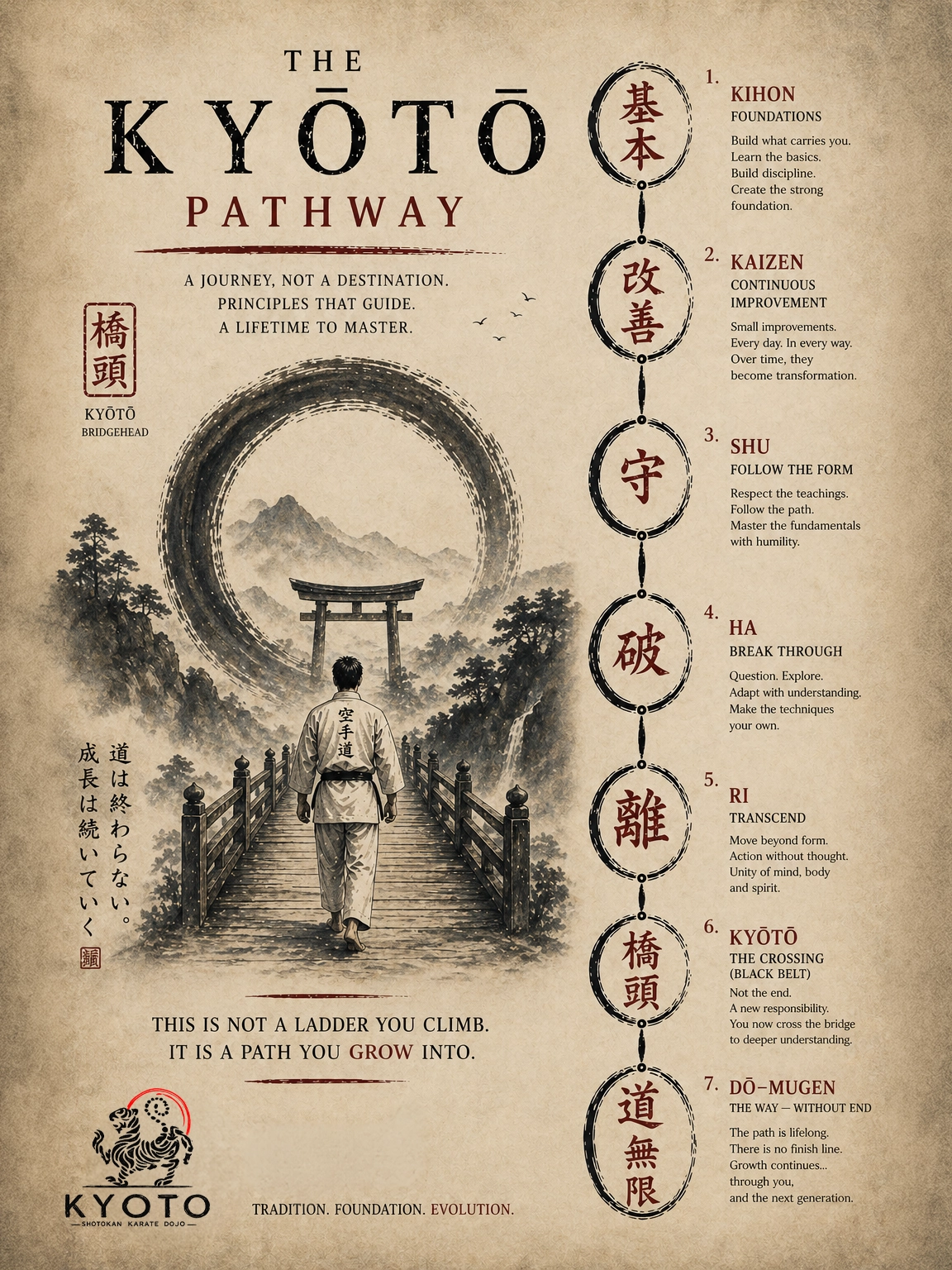 Ha is the fourth stage in the Kyōtō Pathway:
- Foundations (Kihon)
- Continuous Improvement (Kaizen)
- Learning the Form (Shu)
- Understanding the Form (Ha)
- Transcending the Form (Ri)
- Crossing (Kyōtō / Black Belt)
- The Endless Path (Dō–Mugen)
Each stage builds upon the last.
🔗 Continue the journey
👉 Next: Ri (離) — transcending the form
📍 Train with Kyōtō
If you’re looking to begin karate—or continue your training with a traditional approach focused on long-term development—you can learn more here:
👉 About Kyōtō in Bristol
👉 Our Karate Classes
📍 Based in Bristol (BS11)
🥋 Beginners welcome
👨👩👧👦 Family-friendly classes