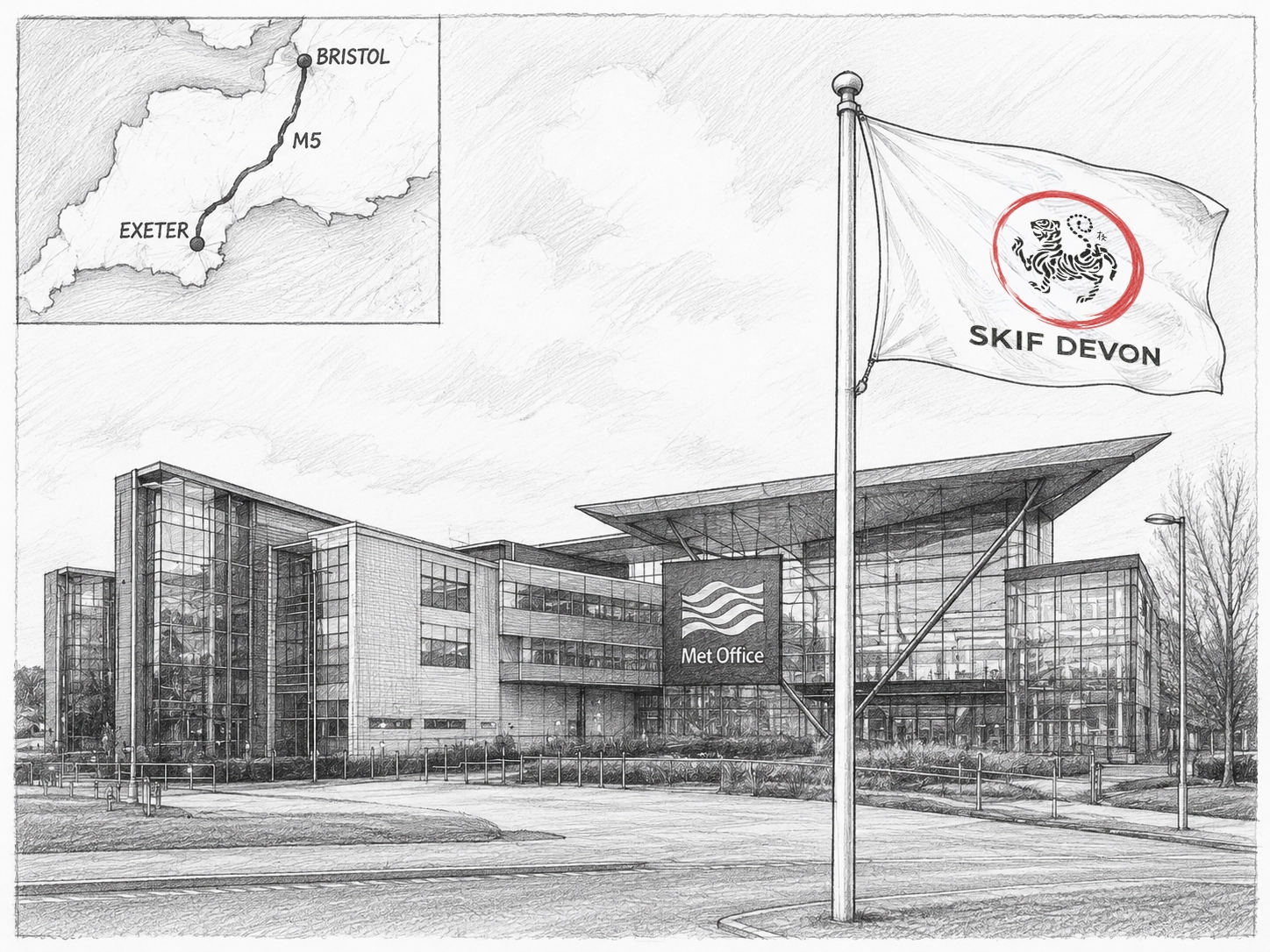
 On Monday 18th May 2026, I had the pleasure of travelling down to Exeter after being invited by Nick Bruce-Jones-sensei to teach at the recently established SKIF Devon dojo, based within the Met Office headquarters.
With no imminent gradings approaching — still around eight weeks away — the focus for the evening was not grading assessment, but simply good quality training and development. That often creates a slightly different atmosphere in the dojo; more relaxed perhaps, but also allowing time to explore details and principles without the pressure of preparing students immediately for examination.
The drive from Bristol to Exeter took around 1 hour 40 minutes, arriving shortly after 4pm. Upon arrival, I was greeted by Nick-sensei and escorted through Met Office security before heading towards the dojo space.
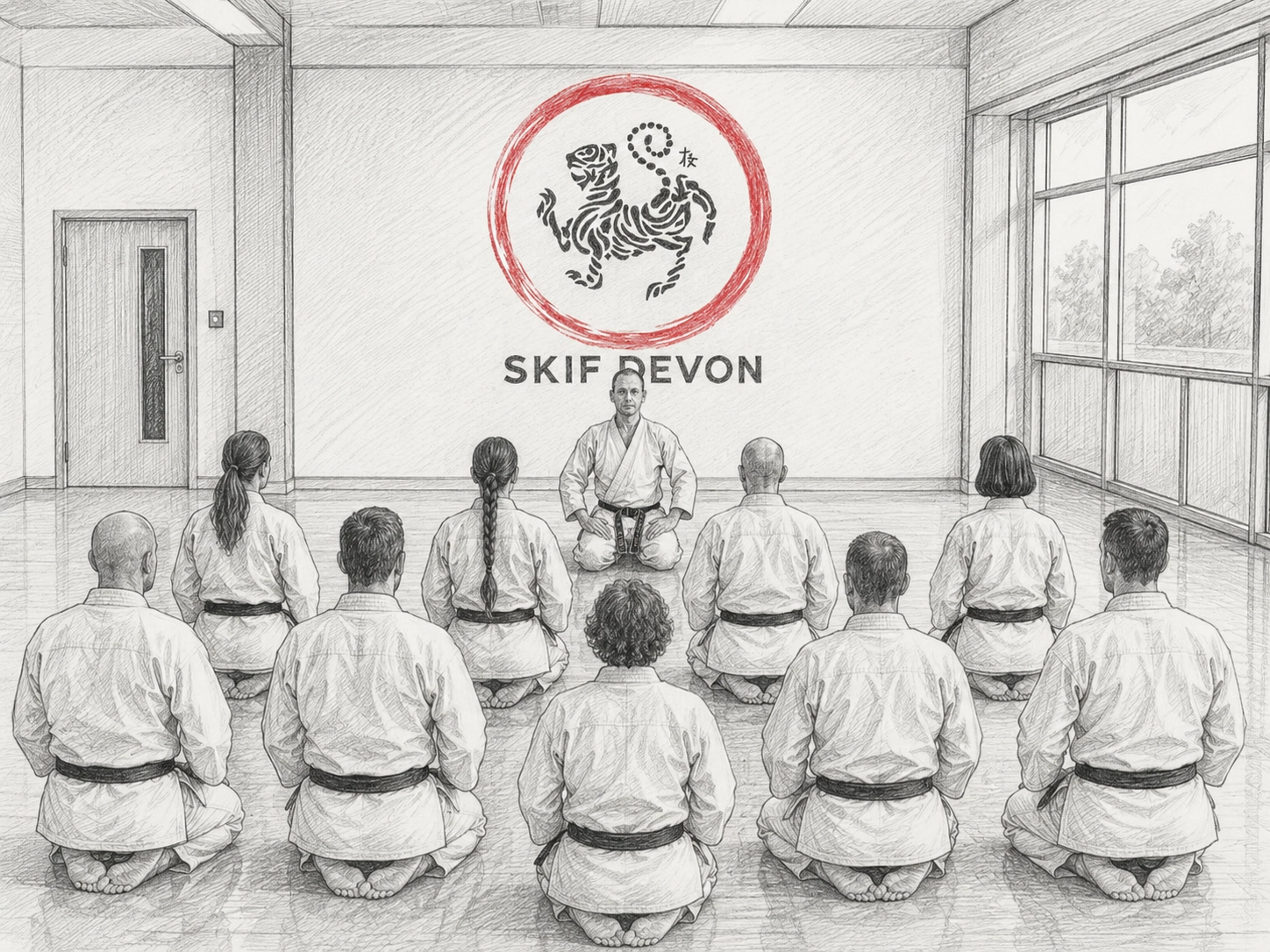 The training hall itself was modest in size — roughly comparable to a small badminton court — but clean, tidy and ideal for focused training. Nick currently teaches two one-hour sessions on Monday evenings (also repeated on Wednesdays and Fridays), fitting neatly into the after-work period. It struck me as an excellent setup for employees finishing a long working day; a chance to de-stress, focus the mind and train together.
The first session ran from 4:30pm to 5:30pm and consisted of nine students including Nick-sensei himself. The group represented a broad range of experience, from beginners with only a few weeks training through to low kyu grades and a couple of returning 1st kyu students who had previously trained in Shotokan under a more JKA-style format before restarting their karate journey under SKIF Devon.
Following the warmup, training began with basic choku-zuki practice. Emphasis was placed on correct hip usage, particularly for the brown belts, encouraging them to compress and load the non-punching hip and leg before driving the technique forwards. Small details such as this often make the difference between simply performing a movement and generating effective power through the whole body.
The session then moved into beginner kihon practice covering:
- Oi-zuki
- Soto-ude-uke
- Shuto-uke
- Mae-geri
Particular emphasis was placed on not allowing the front foot to move prematurely before the technique itself. With mae-geri we then introduced gyaku-zuki afterwards, creating a simple but effective combination and reinforcing transitional movement between techniques.
Students then practiced Gohon Kumite, initially working to count before progressing to independent timing by the third partner rotation. Technical points for the senior grades included avoiding unnecessary shoulder rotation during age-uke and correctly extending the hikite hand during soto-uke. This outward extension can act as an obstruction to the opponent, potentially disrupting their movement before the main blocking action is even completed.
The session concluded with Heian Shodan, where focus was placed on extending the hikite hand during each turning block, helping students better understand directional intent and body coordination within the kata.
At the conclusion of the first class, two students had to leave for home commitments, while another lady joined the dojo for her very first lesson. It was also particularly encouraging to see a mother and daughter — both only recently started in karate — choose to remain and train through the second session as well.
After a brief warmup, the second session introduced mawashi-geri mechanics using a seated exercise. Students sat facing their partner with one leg tucked beneath and the other chambered to the side, mimicking the preparation for the kick itself. From this position they practiced kicking mawashi-geri towards an outstretched hand target.
This exercise is extremely useful for helping students understand the correct horizontal kicking motion without immediately introducing balance and stability concerns. Once the movement pattern becomes more natural, it becomes much easier to transfer into standing practice.
We then progressed into moving mawashi-geri from ju-dachi. For the brown belts, emphasis was placed on proper kamae usage and particularly the use of the arm on the kicking side to create counter-rotation. Without this control it is common for students to over-rotate during the kick and expose their back to the opponent.
The latter part of the session explored kihon-ippon kumite and tai sabaki.
For a chudan attack, the defender moved using a 90-degree body shift in shizentai, wrapping the arm over the attacking limb before folding — rather than rotating — the body into kiba-dachi with empi-uchi. The movement effectively trapped the opponent’s arm between the defender’s back and controlling arm.
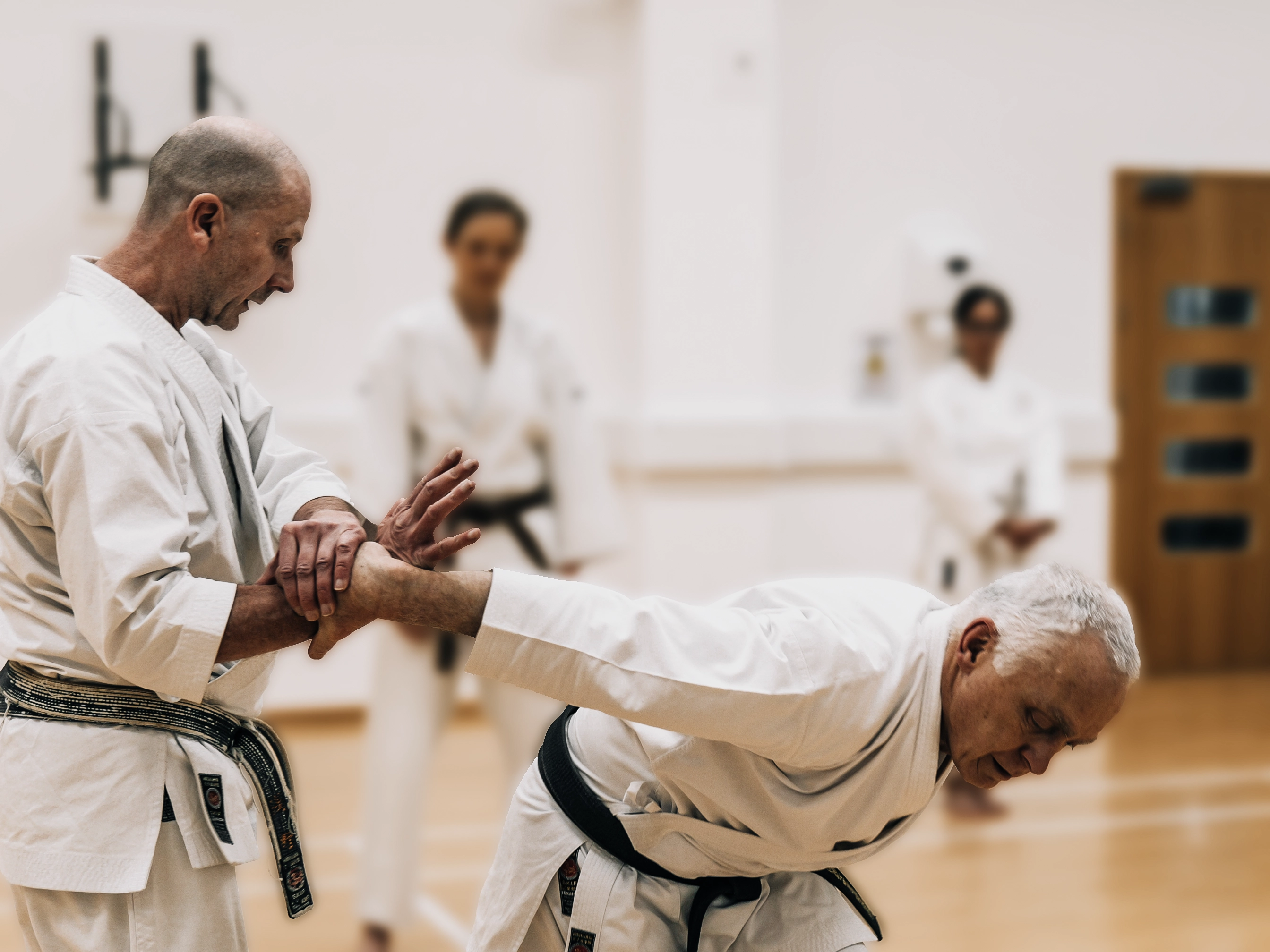
A second exercise worked against a jodan attack using nagashi-uke from a short stance, flowing into arm control, joint manipulation and takedown principles. The blocking arm redirected onto the elbow while the opposite hand secured the wrist before the arm was brought back over the shoulder to unbalance the opponent using body weight rather than strength alone.
This naturally led into a brief introduction on how to fall correctly and safely for the less experienced students.
 The evening finished with Bassai-Dai alongside a brief explanation of the opening bunkai, helping newer students begin to understand that kata movements extend far beyond simple “blocks” and “punches.”
At the conclusion of training, Nick-sensei kindly presented me with a bottle of Japanese Ukiyo Gin as a gift of appreciation — a very thoughtful gesture and greatly appreciated.
Most importantly however, the feedback from the students afterwards was overwhelmingly positive, with everyone expressing how much they had enjoyed the sessions.
It was extremely encouraging to see the continued development of SKIF Devon under Nick-sensei’s instruction. Building a dojo is never easy, particularly in the early stages, but there was already a strong atmosphere within the club — a mixture of serious training, friendly encouragement and genuine enthusiasm to learn.
After the long drive back to Bristol, I finally sat down with a coffee, a small glass of the Ukiyo gin kindly gifted by Nick-sensei, and headed to bed.
Topics