
When karate begins to move beyond conscious thought
🧭 The next stage in the Kyōtō Pathway
After foundations are built through Kihon, refined through Kaizen, structured through Shu, and understood through Ha, the next stage in the Kyōtō Pathway is:
離 (Ri)
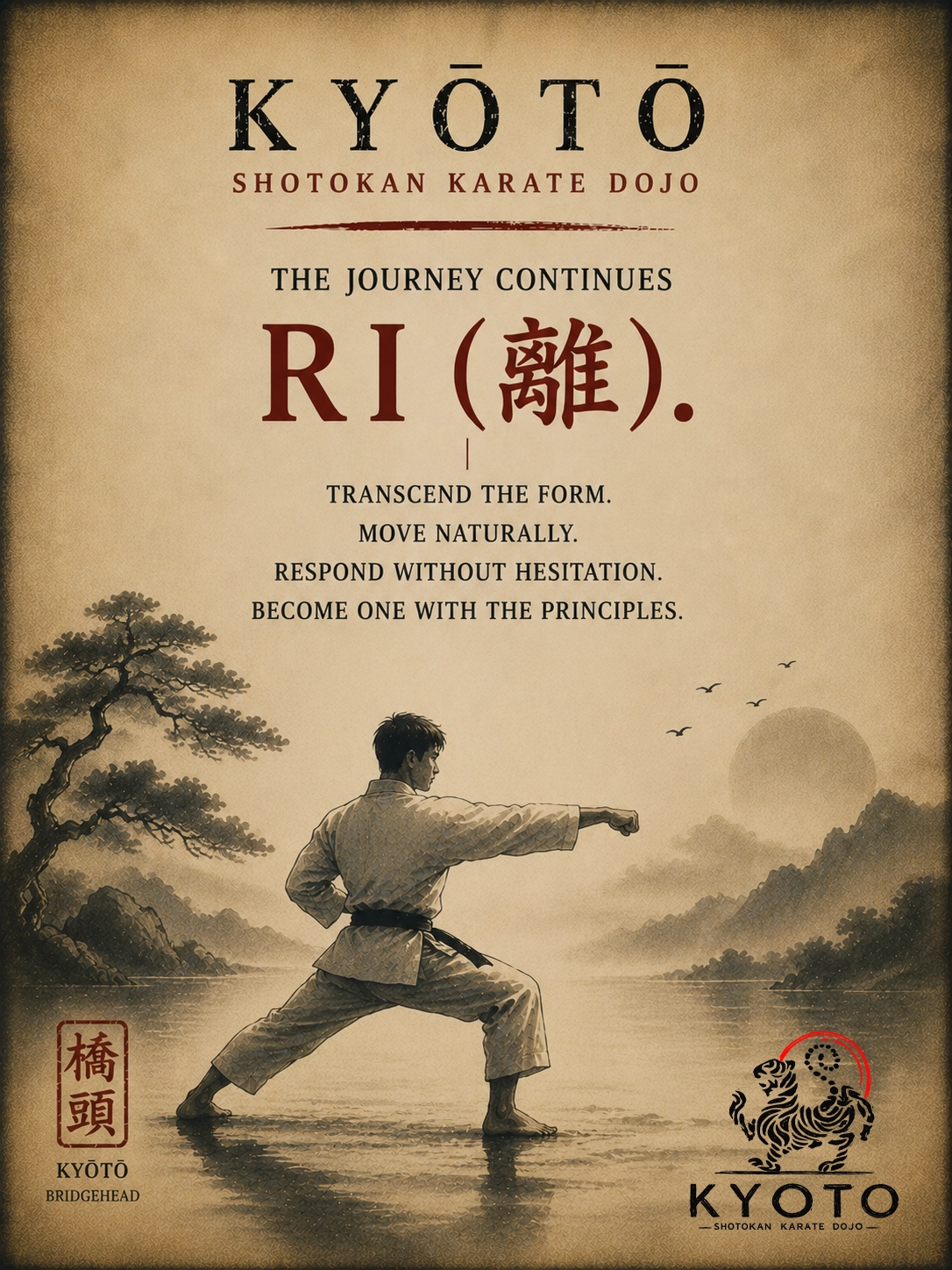 To separate. To transcend. To move beyond the form.
In traditional Japanese martial arts, Ri represents a stage where movement no longer depends upon conscious imitation or deliberate adaptation.
The principles of karate become internalised so deeply that technique begins to emerge naturally.
Not forced.
Not overthought.
Not mechanical.
Simply appropriate.
🥋 Beyond technique
At earlier stages, students think carefully about:
- stance
- timing
- posture
- distance
- sequence
But over years of disciplined training, something begins to change.
The body responds without needing to consciously calculate every movement.
This does not mean training becomes careless.
In fact, the opposite is true.
The fundamentals have become so deeply embedded that they no longer require constant conscious attention.
🌉 Crossing without thinking about the bridge
Imagine crossing a bridge you have walked thousands of times.
At first, every step required attention.
You carefully judged balance and placement.
But eventually, crossing becomes natural.
You no longer think about the structure beneath you.
Yet the structure is still there—supporting every step.
Karate at the Ri stage is similar.
The form has not disappeared.
It has simply become part of you.
🧠 Mushin and natural movement
This stage often connects closely with the concept of Mushin — “no mind.”
Not an empty mind…
but a mind free from hesitation, over-analysis, and unnecessary tension.
At Ri, movement becomes:
- fluid
- responsive
- efficient
- instinctive
The karateka is no longer focused on performing techniques correctly.
Instead, they respond naturally through principles developed over many years.
⚖️ Why Ri cannot be rushed
Ri is often misunderstood as “freedom.”
But true freedom in karate only exists because of the structure built beforehand.
Without foundations:
- movement becomes inconsistent
- adaptation becomes guesswork
- freedom becomes chaos
Ri only exists because:
- Kihon built the structure
- Kaizen refined it
- Shu preserved it
- Ha deepened understanding
True freedom is built upon deep structure.
🌱 The paradox of traditional training
One of the great paradoxes of karate is this:
The more deeply the fundamentals are practised…
the more natural movement eventually becomes.
At first, training can feel rigid.
But over time, rigidity disappears.
Not because structure is abandoned…
but because it has become inseparable from the individual.
🌉 Part of the Kyōtō Pathway
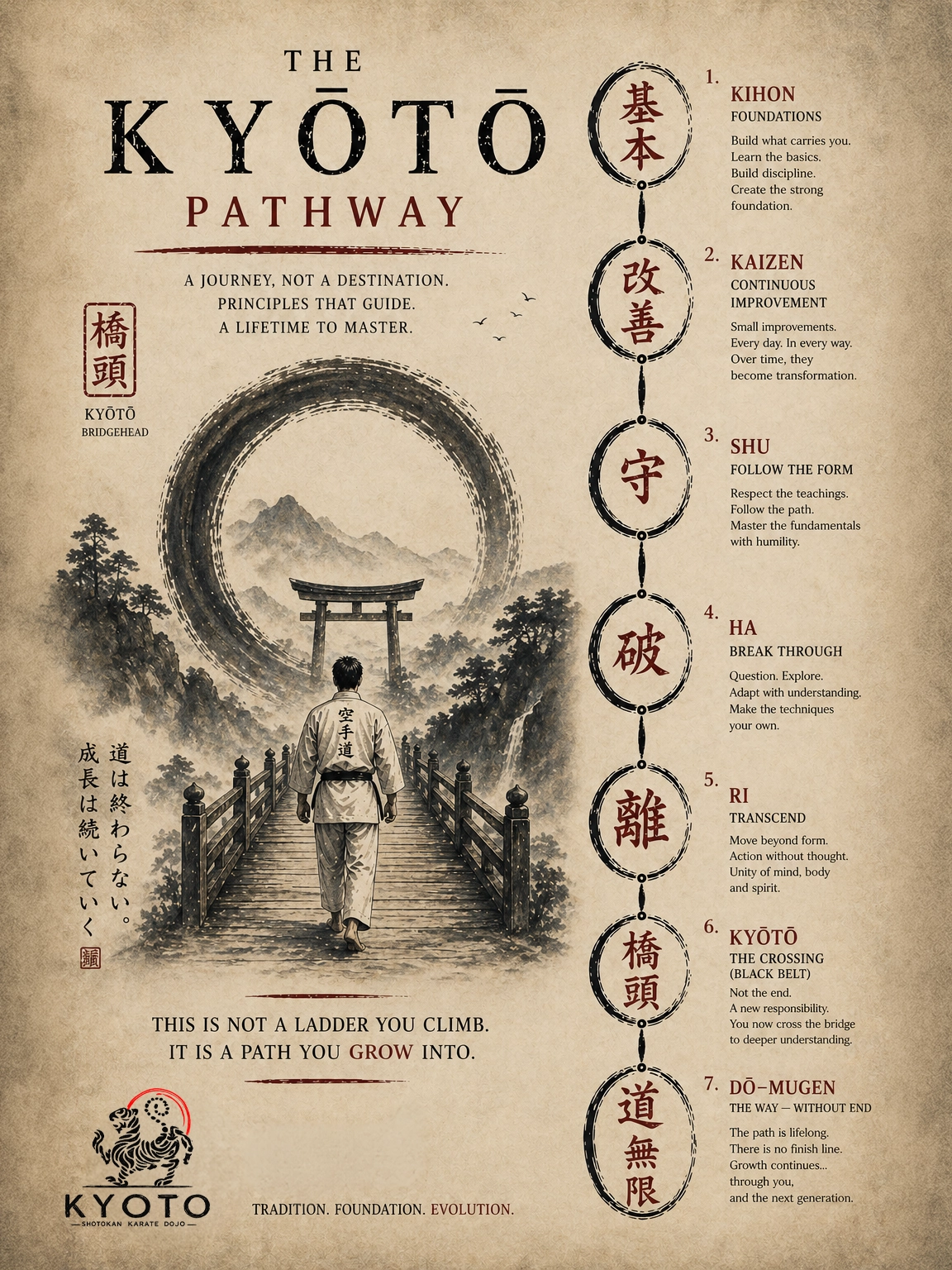 Ri is the fifth stage in the Kyōtō Pathway:
- Foundations (Kihon)
- Continuous Improvement (Kaizen)
- Learning the Form (Shu)
- Understanding the Form (Ha)
- Transcending the Form (Ri)
- Crossing (Kyōtō / Black Belt)
- The Endless Path (Dō–Mugen)
Each stage deepens the one before it.
🔗 Continue the journey
👉 Next: Kyōtō (橋頭) — the crossing point, and why black belt is a beginning rather than an ending
📍 Train with Kyōtō
If you’re looking to begin karate—or continue your training with a traditional approach focused on long-term development—you can learn more here:
📍 Based in Bristol (BS11)
🥋 Beginners welcome
👨👩👧👦 Family-friendly classes
Kyōtō Shotokan Karate Dojo
Bristol (BS11)
🌐 www.kyotokaratebristol.co.uk
📸 Instagram: @kyotokarate
📘 Facebook: /KyotoShotokanKarateClub