
Monday 28 September 2026
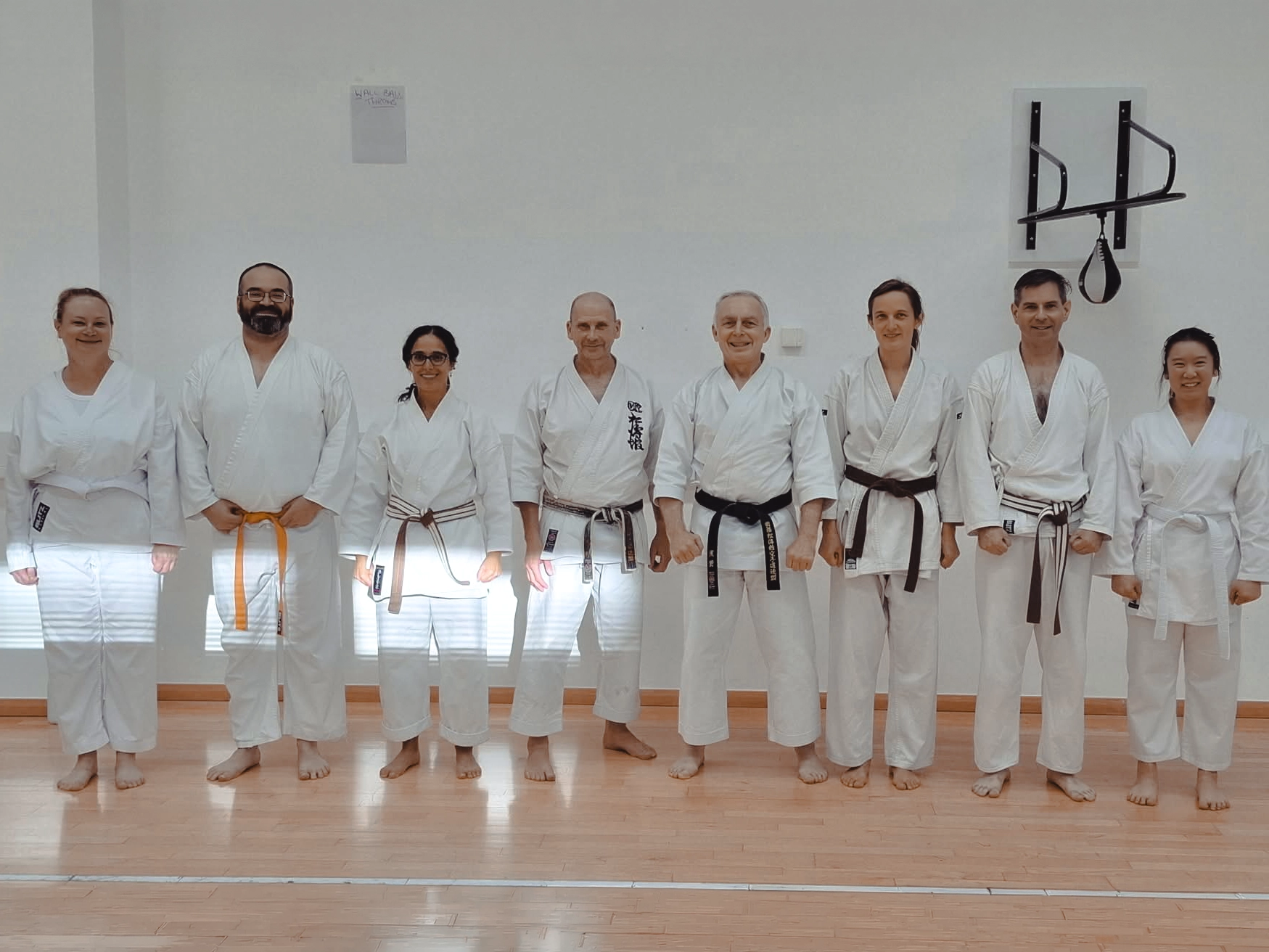
On Monday 28 September, Kyōtō Chief Instructor Steve Ashby travelled to Exeter to teach two sessions at SKIF Devon, the club founded and led by Kyōtō Shihandai Nick Bruce-Jones.
With the Kyōtō Kyū & Mon Grading approaching on Sunday 11 October, the first session of the evening provided an opportunity to return to the fundamentals and look closely at the details that make a significant difference as students progress through their early grades.
Building strong foundations
Seven karate-ka took part in the opening 4:30–5:30pm session, including Bruce-Jones-sensei.
The class began with kihon, concentrating particularly on some of the common mistakes made during the first few grades. Rather than simply correcting technique, the emphasis was on explaining why seemingly small changes matter and how developing good habits early provides a stronger foundation for later karate.
This was followed by gohon kumite, with students working their way along the line and regularly changing partners. Particular attention was given to foot placement when attacking. Beginners can subconsciously avoid stepping into the space occupied by their partner’s foot, altering their technique or direction of travel as a result. The exercise encouraged students to trust their movement and maintain the correct line of attack.
For the defender, the focus switched to maai — establishing and maintaining the appropriate distance without leaning forward or compromising posture.
The first session concluded with Heian Shodan, looking closely at stance and at extending the arm that will subsequently become the hikite hand. Once again, the theme was that relatively subtle details can have a considerable effect on the finished technique.
From kihon to jiyū kumite
With two students needing to leave after the first hour, the 5:30–6:30pm session changed direction and moved towards more free-flowing jiyū kumite principles.
Students initially worked on moving with yori-ashi, combining kizami-zuki and gyaku-zuki. The movement was then adapted to become lighter and quicker, with students encouraged to stay mobile on the toes and use a small hopping action rather than relying solely upon a conventional shifting movement — particularly useful when considering competition kumite.
The combination was then taken into partner work before developing into a tactical exercise.
Instead of simply attacking, the initiator moved quickly into the opponent’s space before immediately withdrawing. The intention was to encourage — or bait — the opponent into responding with gyaku-zuki. That counter could then be parried and countered in turn.
The analogy used was fishing: rather than chasing the opponent, offer them the bait and encourage them to make the movement you want.
It was a useful introduction to the idea that kumite is not simply about being faster or stronger. Distance, timing and movement can be used to influence an opponent’s response and create an opportunity.
The evening finished by returning to kata, with practice of Heian Nidan followed by Jion.
A welcome return to Devon
It was another enjoyable opportunity to work with the students at SKIF Devon and to teach two deliberately contrasting sessions — beginning with the fundamental kihon, kata and gohon kumite required to build good karate, before exploring how those same principles of movement, distance and timing can develop into more dynamic jiyū kumite.
At the end of training, Bruce-Jones-sensei thanked Ashby-sensei for the evening’s instruction and presented him with a bottle of Japanese gin — a very welcome and unexpected gift to round off the visit.
Oss.