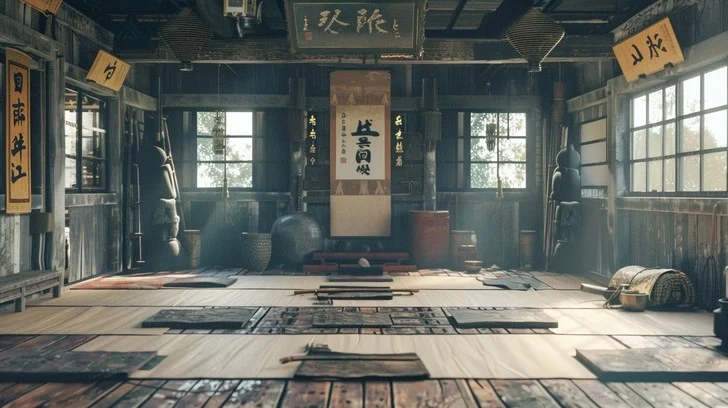
Walk into a traditional karate dōjō and one of the first things you notice is the floor beneath your feet. Sometimes it is polished wood, sometimes modern sports flooring, and sometimes it is a soft interlocking surface commonly referred to as tatami (畳).
Most karateka think of tatami simply as mats used for comfort or safety. But within Japanese culture and traditional martial arts, tatami represents far more than padded flooring. It shapes movement, etiquette, mindset, and even the atmosphere of training itself.
For traditional karate clubs such as Kyōtō (橋頭), the training surface becomes part of the dōjō environment — another element that influences how we move, think, and practise.
What Does “Tatami” Mean?
 The word tatami (畳) literally means “folded” or “stacked.” Historically, tatami were woven straw floor coverings used in Japanese homes, temples, tea rooms, and noble residences.
Traditional tatami mats were constructed from:
- A tightly packed rice-straw core
- A woven rush-grass surface (igusa)
- Cloth edging (heri)
They were not originally martial arts mats at all. They were part of Japanese daily life and culture.
Over time, martial arts training adopted tatami because they provided:
- Grip
- Slight cushioning
- Stability
- A clearly defined training space
Modern martial arts tatami are usually made from foam or synthetic materials, but the name remains rooted in Japanese tradition.
Tatami in Traditional Karate
Interestingly, traditional Shotokan karate was not originally developed on modern competition mats.
Early Okinawan and Japanese karate training often took place on:
- Wooden dōjō floors
- School halls
- Courtyards
- Outdoor areas
- Hard surfaces with very little cushioning
This mattered because the floor influenced movement itself.
Hard surfaces encourage:
- Strong rooting
- Stable stances
- Efficient body alignment
- Controlled impact
- Awareness of balance
Too much softness can hide technical weaknesses.
This is one reason many traditional instructors still believe karateka should experience a variety of training surfaces rather than relying entirely on ideal competition conditions.
The Reality of Training Floors at Kyōtō
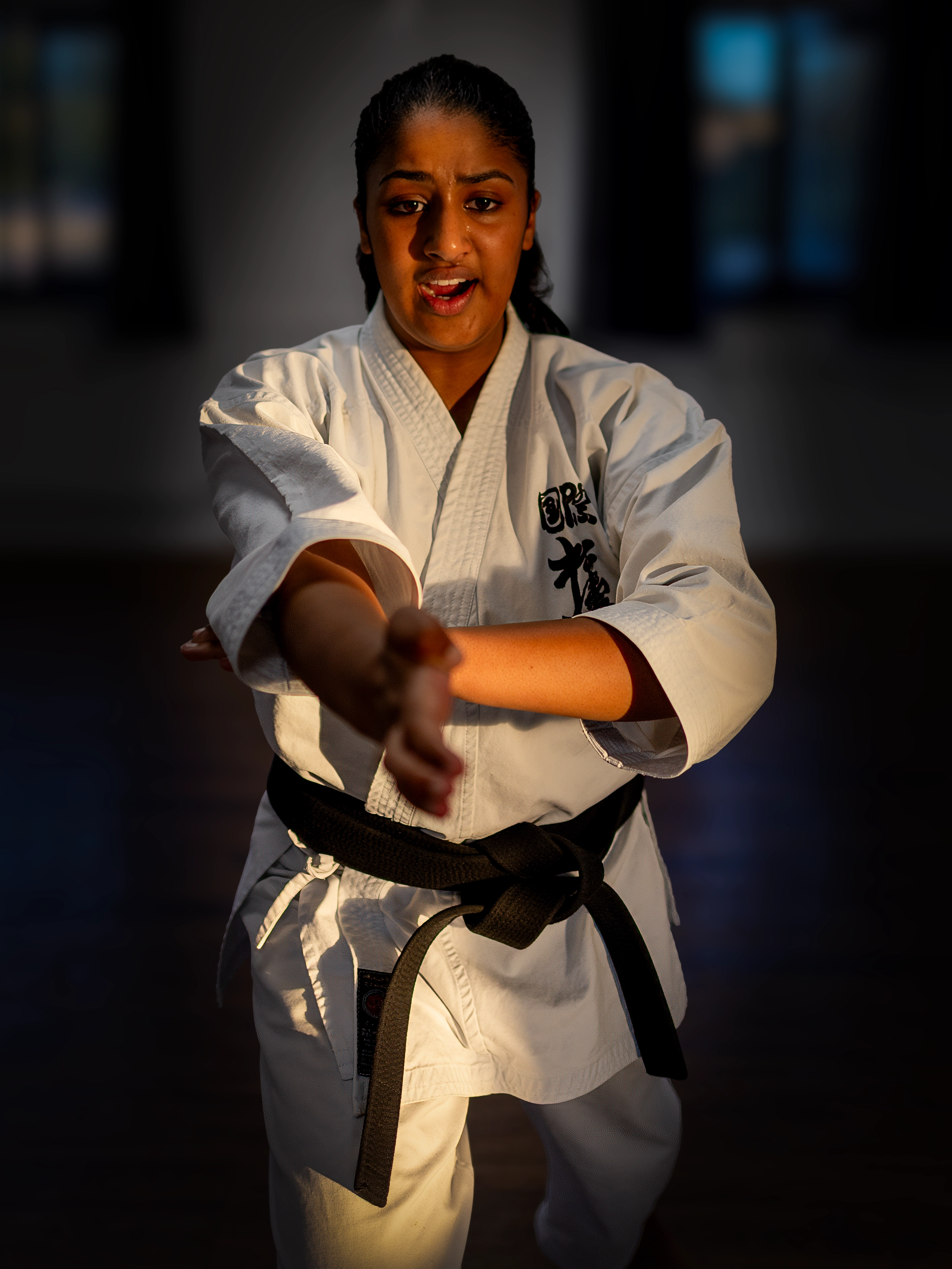 At Kyōtō (橋頭), we train in real community venues:
- Sports halls
- School facilities
- Multi-use centres
The floor is often simply “what it is.”
Sometimes that means:
- Wooden sports flooring
- Hard hall surfaces
- Slightly slippery conditions
- Different grip levels depending on temperature or humidity
Rather than seeing this as a disadvantage, it actually develops adaptability.
Karate should not become dependent upon perfect conditions.
A karateka learns to:
- Adjust stance pressure
- Control balance
- Adapt footwork
- Understand surface grip
- Generate power appropriately for the environment
In many ways, this reflects traditional budō more honestly than always training on idealised mats.
The floor itself becomes part of training.
Why We Use Tatami for Squad Training
That said, tatami absolutely has an important place within modern karate.
For regional squad sessions at St Bede’s Catholic College, Kyōtō lays down a full 12m × 12m competition tatami area for training.
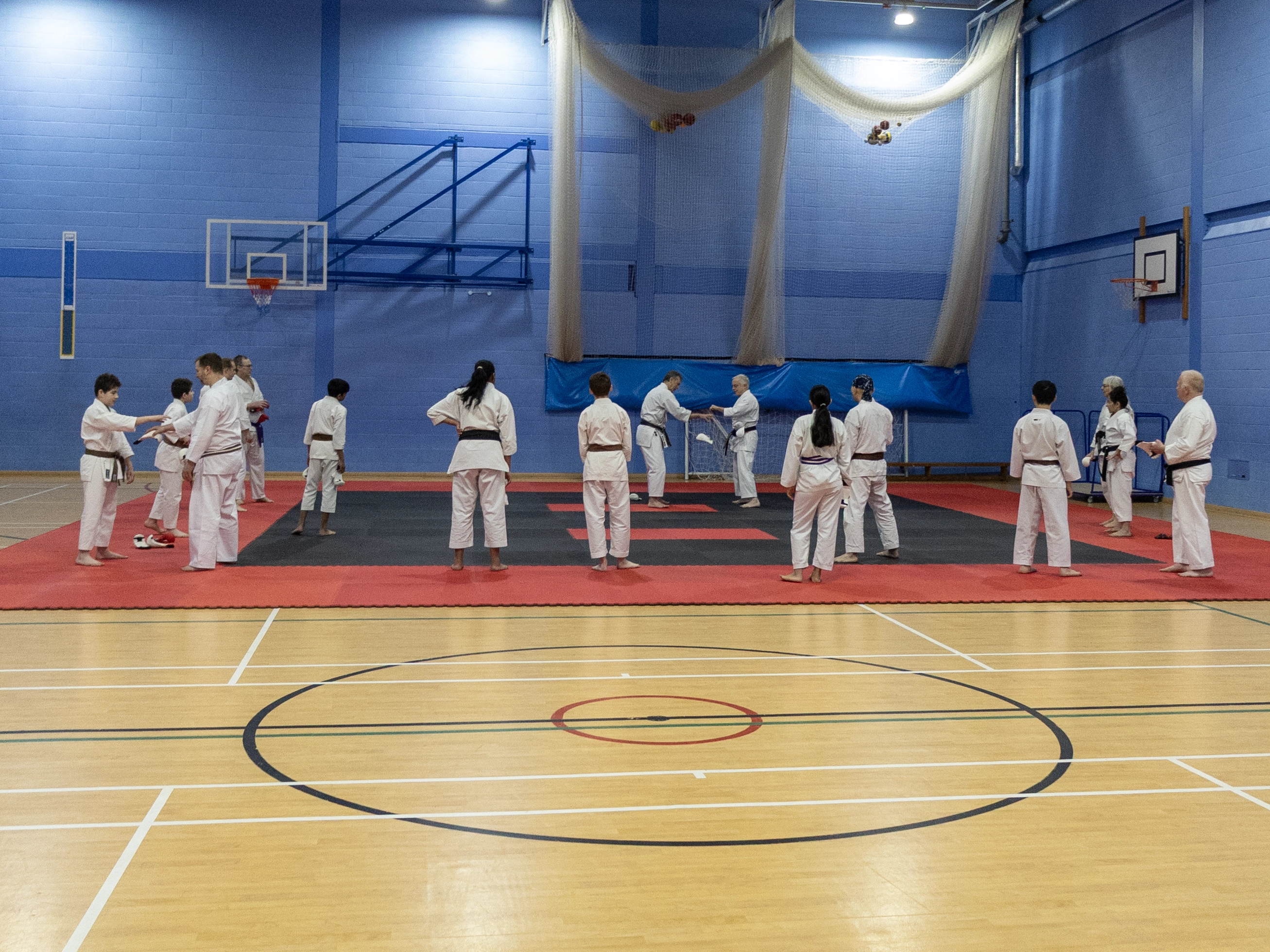 This creates an environment much closer to:
- Tournament conditions
- Regional and national championships
- SKIF international competition settings
- Performance-based kumite & kata movement
The competition area changes the feeling of training immediately.
Students experience:
- Defined boundary awareness
- Competition spacing
- Different grip and movement dynamics
- Faster directional changes
- Greater confidence with explosive movement
For squad preparation, this is extremely valuable.
Learning to Adapt
One of the most important lessons is learning the difference between surfaces.
A karateka who can only move well on competition tatami may struggle elsewhere.
Likewise, a karateka who only trains on hard floors may initially find competition movement unfamiliar.
Training across both environments develops versatility.
At Kyōtō, students therefore experience:
- Everyday training on practical hall surfaces
- Squad and competition preparation on tatami
- Exposure to changing conditions
- Realistic adaptability
This creates more complete karateka.
Tatami and Maai (間合い)
Competition mats subtly affect maai (間合い) — distancing and timing.
Modern tatami generally provide:
- More grip
- More confidence in explosive lunging
- Faster directional recovery
- Safer sliding and recovery
This changes:
- Entry timing
- Kumite rhythm
- Attack commitment
- Evasion patterns
Students often notice they move differently the moment they step onto a proper competition area.
That awareness itself becomes valuable experience.
Building the Competition Mindset
There is also something psychological about laying down a dedicated tatami area.
The act itself transforms the hall.
A normal school sports hall suddenly becomes:
- A competition space
- A serious training environment
- A place requiring focus and discipline
The boundaries of the mat encourage a different mentality.
Students become more aware of:
- Positioning
- Ring control
- Tactical movement
- Spatial pressure
In this sense, tatami helps bridge the gap between ordinary training and competitive performance.
Tatami and Kyōtō Philosophy
At Kyōtō (橋頭), we often speak of the “bridgehead” philosophy — the point between one stage and another.
The tatami reflects this idea perfectly.
For everyday classes, we train on ordinary surfaces because karate must function in the real world, not only in ideal conditions.
For squad sessions, we construct a dedicated 12m × 12m competition environment because students also need experience within the specialised world of tournament karate.
Both are important.
One develops adaptability.
The other develops performance readiness.
Together, they create rounded karateka capable of moving confidently in any environment.
Final Thoughts
Tatami is far more than padded flooring.
It changes:
- Movement
- Timing
- Mindset
- Atmosphere
- Confidence
But perhaps the most important lesson is this:
A karateka should never become dependent on the floor beneath them.
Whether training on:
- Wood
- Sports hall flooring
- Tatami
- Grass
- Concrete
- Sand
…the principles of karate must remain the same.
The environment changes.
The karateka adapts.
Topics