
Why black belt is not the end of the journey—but the beginning of deeper understanding
🧭 The next stage in the Kyōtō Pathway
After foundations are built through Kihon, refined through Kaizen, structured through Shu, deepened through Ha, and internalised through Ri, the next stage in the Kyōtō Pathway is:
橋頭 (Kyōtō)
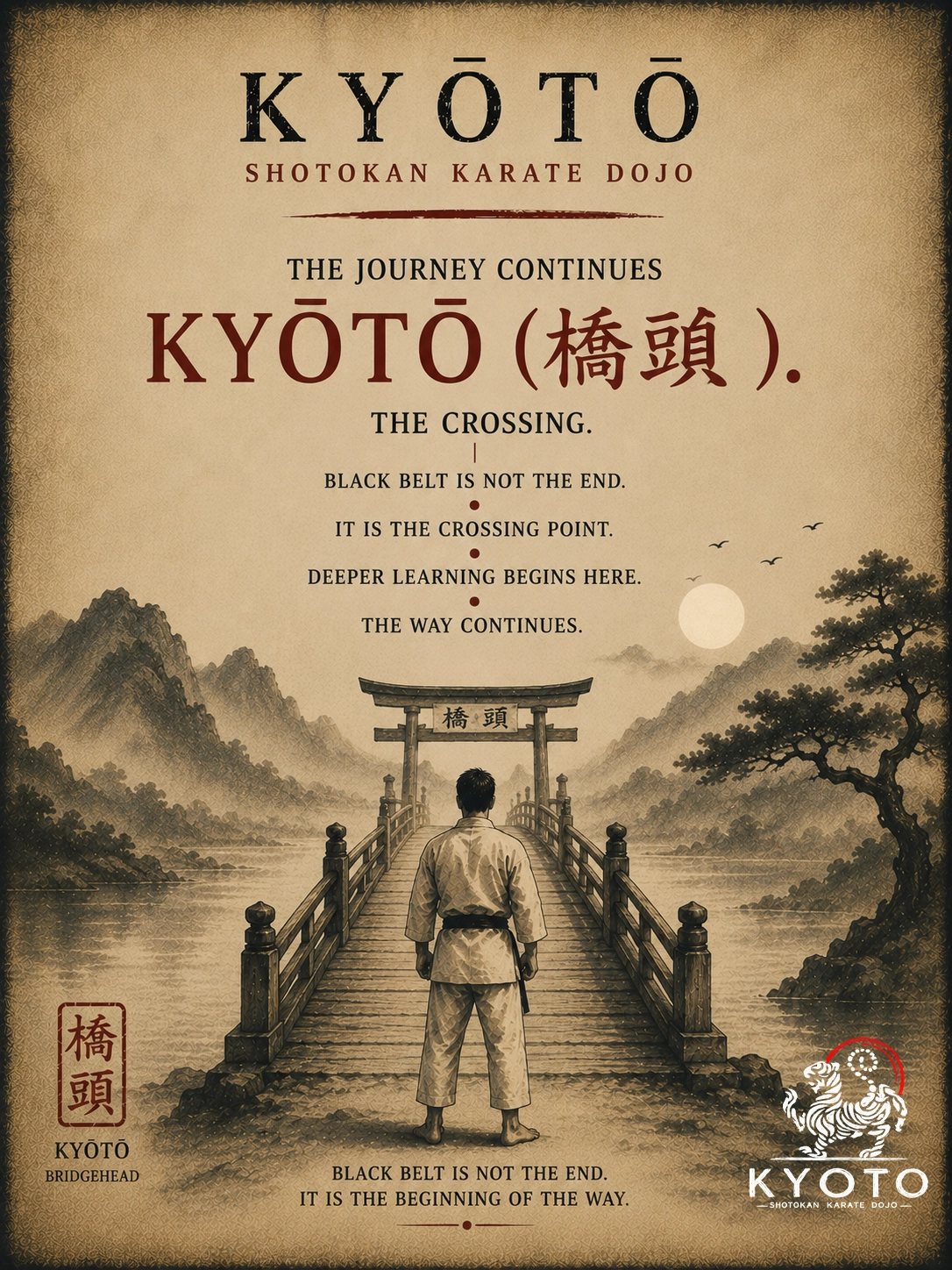 Bridgehead. The crossing point.
At first glance, many people see black belt as the destination.
The point where training is “complete.”
The moment someone becomes an expert.
But in traditional karate, this is not how black belt has ever truly been understood.
Black belt is not an ending.
It is the crossing.
🌉 What a bridgehead really means
The name Kyōtō (橋頭) refers to a bridgehead—a point of crossing from one side to another.
Historically, a bridgehead was not the end of a journey.
It was the critical point where progress continued forward.
A place of transition.
A place of commitment.
A place from which deeper movement could begin.
This reflects traditional karate perfectly.
🥋 Why black belt changes everything
Before black belt, much of training is focused on:
- building structure
- learning discipline
- developing movement
- understanding principles
But eventually, there comes a point where the student is no longer simply learning karate…
They are beginning to truly study it.
The fundamentals are now stable enough that deeper understanding can emerge.
This is why many traditional instructors say:
Black belt is not mastery. It is the point where real learning begins.
🧠 The crossing from imitation to ownership
Earlier stages in training involve:
- copying
- refining
- understanding
- adapting
But at the crossing, karate begins to become inseparable from the individual.
Not as performance.
Not as memorised technique.
But as part of how they move, think, and approach challenges.
The student no longer stands at the edge of the bridge wondering whether they can cross.
They are already moving forward.
🌱 Responsibility beyond technique
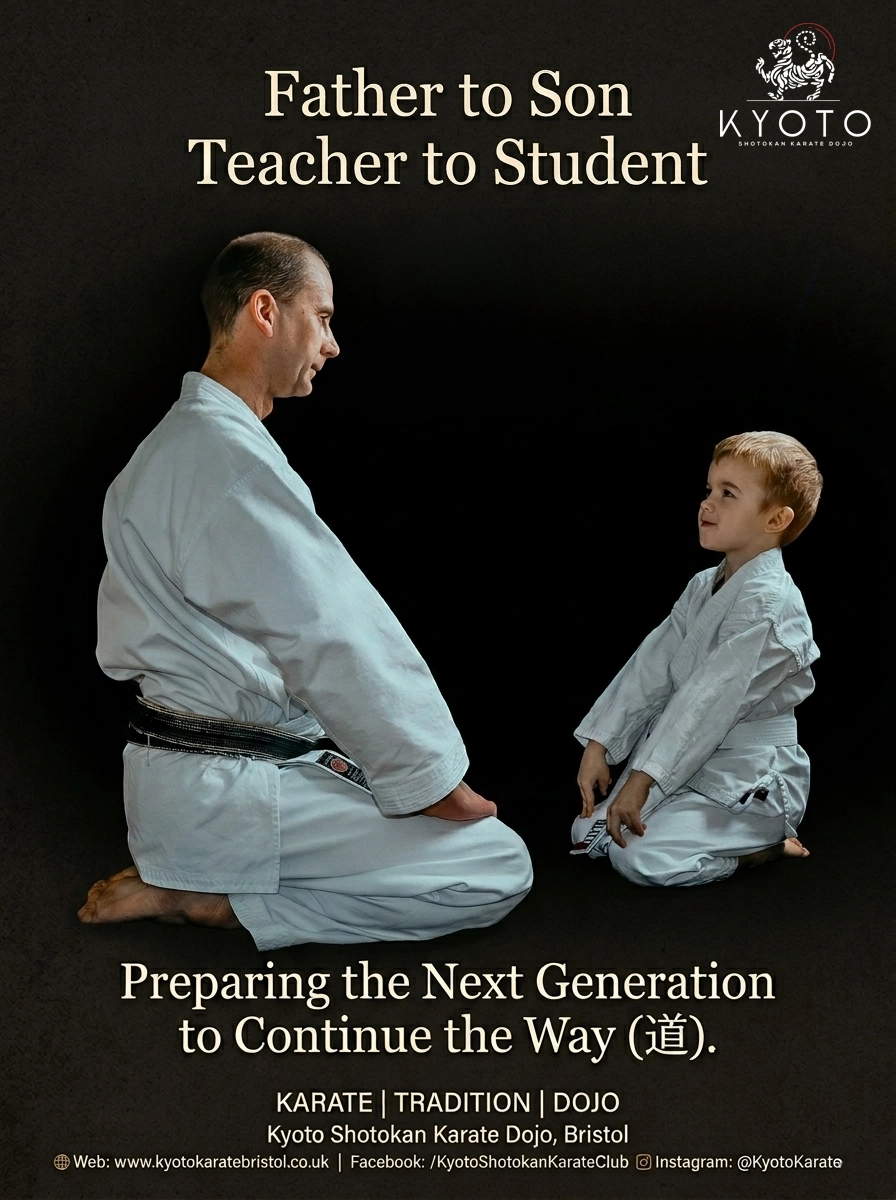 Black belt also brings responsibility.
Not just technical responsibility…
but responsibility in:
- attitude
- humility
- consistency
- helping others develop
- preserving standards while continuing to grow
Because the crossing is not travelled alone.
As one generation crosses, another begins the journey behind them.
⚖️ Why the journey does not end here
In many ways, black belt can be dangerous if misunderstood.
If treated as a final destination, growth stops.
But traditional karate was never intended to end at rank.
There is always:
- refinement
- deeper understanding
- changing perspective
- continued growth through age and experience
The crossing is not the destination. It is the point where the horizon becomes wider.
🌉 Part of the Kyōtō Pathway
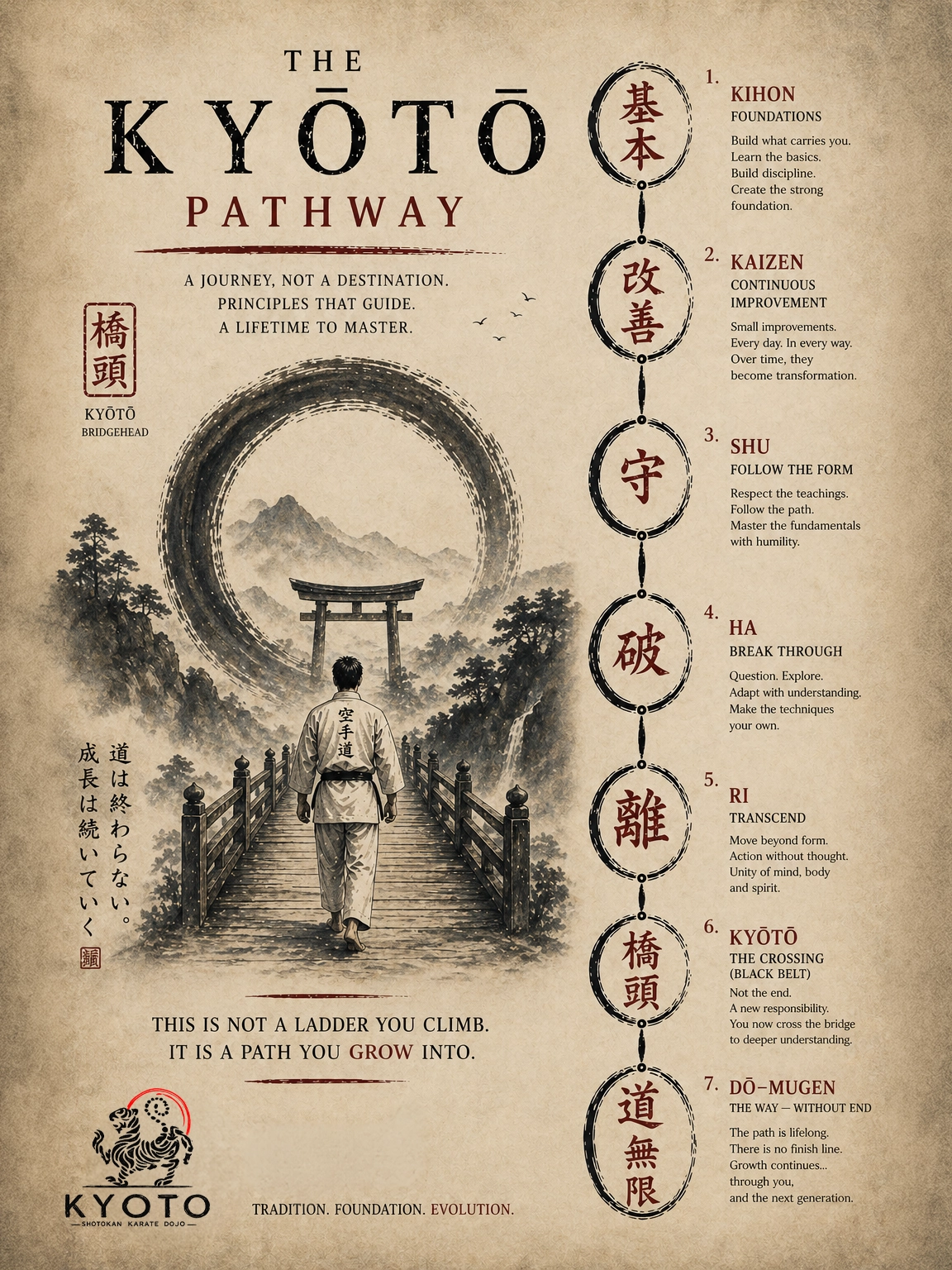 Kyōtō (橋頭) is the sixth stage in the Kyōtō Pathway:
- Foundations (Kihon)
- Continuous Improvement (Kaizen)
- Learning the Form (Shu)
- Understanding the Form (Ha)
- Transcending the Form (Ri)
- The Crossing (Kyōtō / Black Belt)
- The Endless Path (Dō–Mugen)
Each stage prepares the next.
🔗 Continue the journey
👉 Next: Dō–Mugen (道・無限) — the way without end
📍 Train with Kyōtō
If you’re looking to begin karate—or continue your training with a traditional approach focused on lifelong development—you can learn more here:
👉 About Shotokan
👉 About our Karate classes
📍 Based in Bristol (BS11)
🥋 Beginners welcome
👨👩👧👦 Family-friendly classes
Kyōtō Shotokan Karate Dojo
Bristol (BS11)
🌐 www.kyotokaratebristol.co.uk
📸 Instagram: @kyotokarate
📘 Facebook: /KyotoShotokanKarateClub