
Even Monkeys Fall From Trees
One of my favourite Japanese proverbs is:
猿も木から落ちる
Saru mo ki kara ochiru
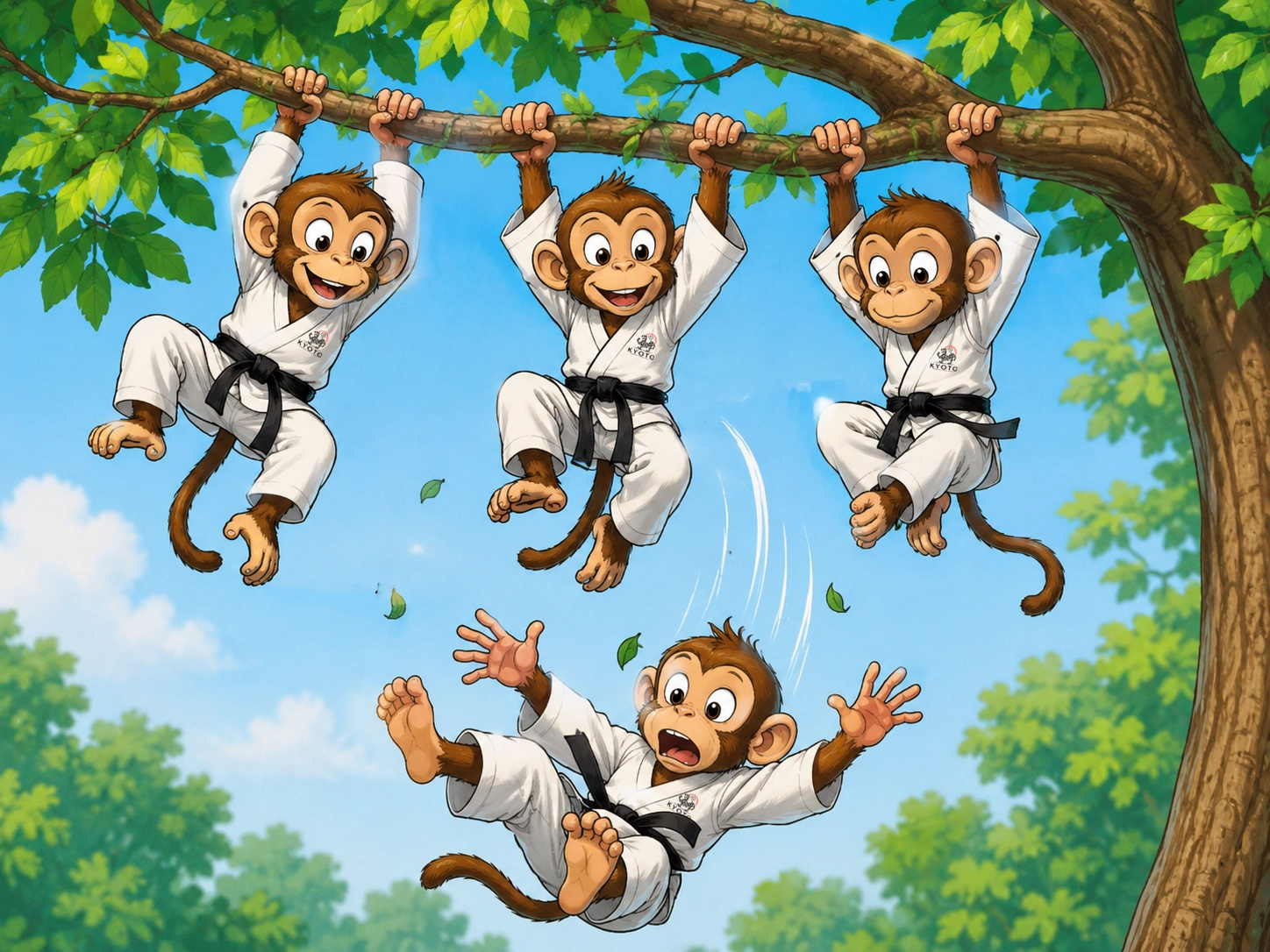
“Even monkeys fall from trees.”
It is beautifully simple.
A monkey spends its life climbing trees. If there is one creature that should never lose its footing, surely it is a monkey.
Yet occasionally it does.
The proverb reminds us that experience does not eliminate mistakes. No matter how skilled we become, we remain human.
As karateka, that is an important lesson.
My Own Monkey Tree Moment
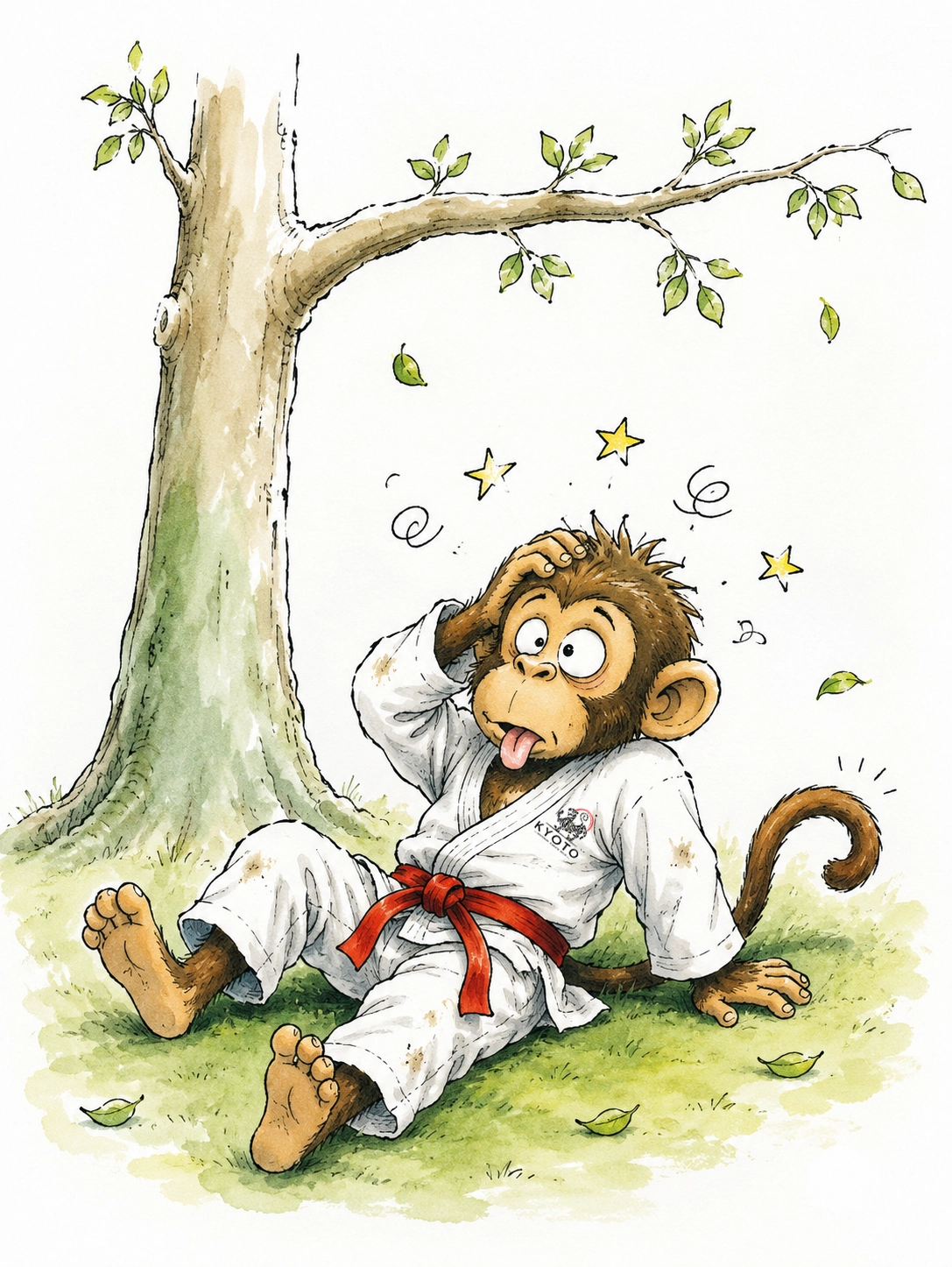
I experienced my own Saru mo Ki Kara Ochiru moment during a recent training course with Aragane-sensei.
As many of our students know, when I demonstrate kata during class, I often perform it in mirror form. If I move to my right, the students move to their left. This allows everyone to copy the correct direction whilst I can still watch the class without constantly looking over my shoulder.
After decades of teaching, it has become second nature.
Then Aragane-sensei called everyone together for Heian Yondan.
Without thinking, I instinctively demonstrated the kata exactly as I would in one of our Kyōtō classes.
The kata begins by moving to the left.
I confidently stepped to the right into kokutsu dachi.
The second movement turns the opposite way.
I confidently turned left.
Only then did I realise something wasn’t quite right.
Everyone else in the dojo was facing towards the right - I was facing everyone else.
For a brief moment, I was performing my own unique version of Heian Yondan.
It was one of those moments where you simply smile to yourself and think:
“Well… even monkeys fall from trees.”
The Difference Between Knowledge and Habit
What fascinated me afterwards wasn’t the mistake itself.
It was why it happened.
I didn’t forget the kata.
I didn’t misunderstand the sequence.
In fact, the mistake happened because of something I’ve practised for years.
Teaching.
The brain is incredibly good at creating habits. Good coaching often relies on repetition until movements become automatic.
Ironically, the same automatic habits that make us better instructors can occasionally catch us out in unfamiliar situations.
Rather than being embarrassed, I found it a fascinating reminder that learning never stops.
Purposeful Play Isn’t Just for Beginners
During UK Coaching Week, the theme was Purposeful Play—creating environments where people feel safe to experiment, make mistakes, laugh, adapt and improve.
Although we often associate play with children, the principle applies equally to experienced martial artists.
If we become so concerned about looking perfect that we never risk making mistakes, we also stop learning.
A dojo should be somewhere you feel confident enough to try, fail, adjust and try again.
Sometimes that means getting the direction wrong in front of everyone.
Sometimes it means laughing at yourself before carrying on.
That is purposeful learning.
Learning Through Failure
Recently we also explored the idea of Learning Through Failure.
Failure has an unfortunate reputation.
People often see mistakes as evidence that they aren’t good enough.
Traditional budō teaches something very different.
Mistakes are information.
Every missed technique, forgotten kata sequence or incorrect stance gives us valuable feedback.
Without mistakes, instructors have nothing to correct.
Without correction, improvement slows.
The monkey falling from the tree isn’t proof that it cannot climb.
It’s simply another opportunity to climb better next time.
The Best Coaches Never Stop Being Students
One message that stood out throughout UK Coaching Week was that great coaches are lifelong learners.
That resonated with me.
I’ve been practising Shotokan karate for over forty years.
I still attend courses.
I still ask questions.
I still make mistakes.
I still get corrected.
And I’m genuinely pleased that I do.
The day we believe we’ve got nothing left to learn is probably the day our progress begins to slow.
A Kyōtō Perspective
At Kyōtō, we don’t expect perfection.
We expect effort.
Whether you’re a white belt learning your first front stance or a black belt polishing advanced kata, mistakes are simply part of the journey.
Some of our most popular recent articles—including Learning Through Failure, Purposeful Play in Karate, Doki Doki, Oubaitori, and Kokochi—all share the same underlying message.
Everyone learns differently.
Everyone progresses at their own pace.
Everyone experiences moments of uncertainty.
And everyone, from beginner to instructor, occasionally falls out of the tree.
The important part isn’t avoiding the fall.
It’s smiling, standing back up, bowing, and climbing again.
Because that is where improvement happens.
猿も木から落ちる
Even monkeys fall from trees.
And perhaps that’s exactly why we continue training.