
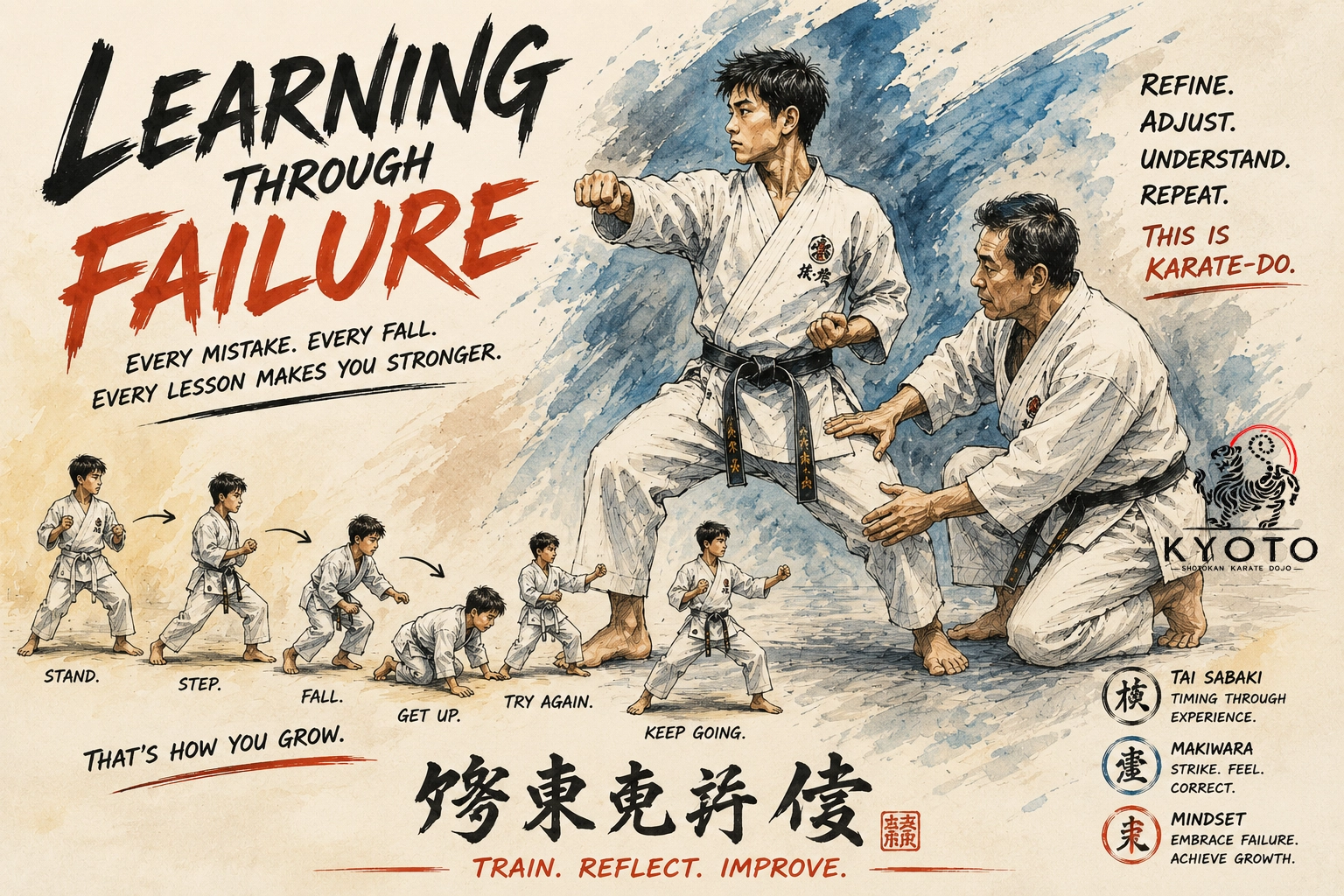
In modern life, failure is often treated as something negative. We are encouraged to avoid mistakes, avoid embarrassment, and avoid getting things wrong. Yet in karate, failure is not the opposite of learning — failure is learning.
A student who never fails is usually a student who is not testing their limits.
Traditional karate training has always understood this. Improvement does not come from endless success. It comes from trying, adjusting, failing, refining, and trying again.
Falling Down to Learn to Stand
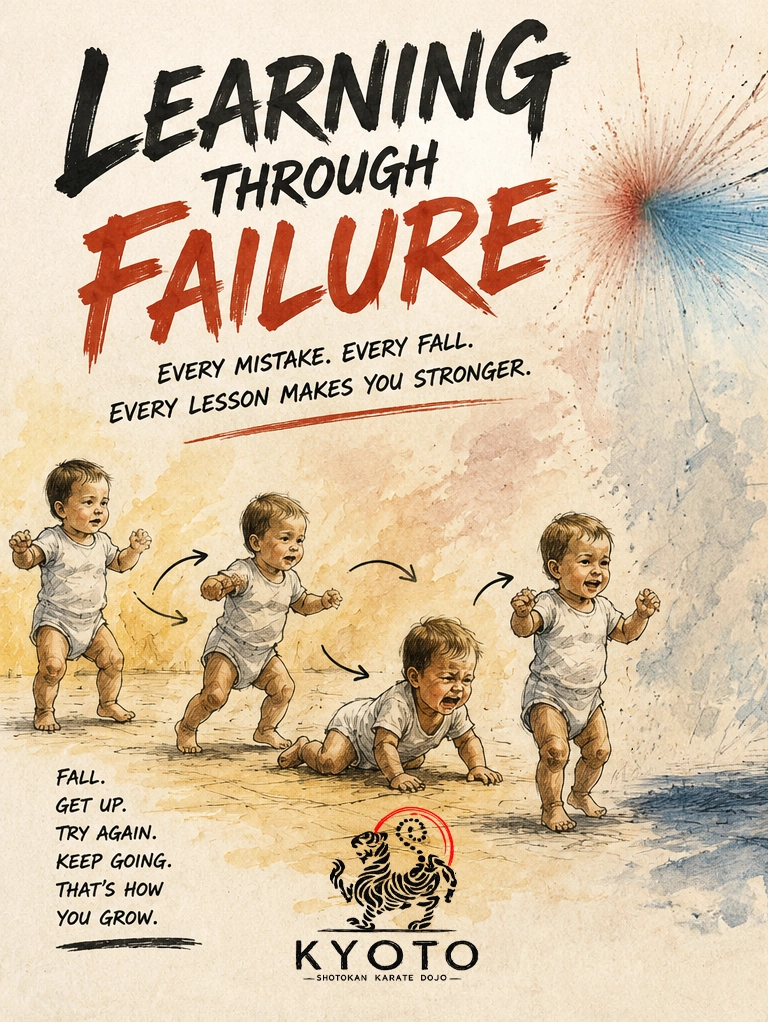 I often use the analogy of a baby learning to walk.
A toddler pulls themselves upright, takes a step… and falls over.
Then they stand again.
One step. Fall.
Two steps. Fall.
Three steps. Fall.
Eventually, they walk across the room without thinking.
The child has not learned through explanation alone. They have learned through repeated failure and correction. Their body gradually understands balance, posture, timing, and how the shifting centre of gravity changes as the legs move.
Karate works exactly the same way.
A student learning tai sabaki (body evasion) will often move too early and still get hit.
Then they move too late and still get hit.
Then they overcommit their body movement and lose balance.
Eventually, through repeated failure, timing begins to emerge naturally.
The body learns what the mind cannot fully explain.
The Importance of “Safe Failure”
Educational theory strongly supports this approach.
Psychologist Lev Vygotsky described the Zone of Proximal Development — the idea that learning happens just beyond current ability. If something is too easy, no adaptation occurs. If it is impossibly difficult, learning shuts down. Growth occurs in the uncomfortable middle ground where mistakes happen.
Similarly, Carol Dweck developed the concept of the Growth Mindset: the belief that ability develops through effort, correction, and persistence rather than fixed talent.
Karate training naturally embodies these ideas.
A dojo should be a place where students are allowed to fail safely.
Not humiliated.
Not mocked.
But challenged.
A student who never misses a technique is probably moving too slowly. A student who never gets caught by a counterattack is probably not exploring their range or timing deeply enough.
The Body Must Experience Failure
Some lessons cannot be understood intellectually.
Take punching.
A student can be told a hundred times to keep the wrist straight. They may nod and understand the instruction conceptually. But until they strike something solid — a makiwara, pads, or an opponent — they may never truly understand why.
The moment the wrist bends slightly on impact and the technique collapses, the body receives immediate feedback.
Failure teaches structure.
The correction becomes real.
This is one reason traditional tools such as the makiwara were so important. They exposed weakness honestly. Not to injure the student, but to educate them.
The body learns faster when reality answers back.
This also applies to kamae, distancing, breathing, hikite, and zanshin. Weaknesses become visible through failure.
Error-Based Learning
Modern motor-learning research refers to this as error-based learning.
The nervous system constantly compares:
- what it intended to do,
- what actually happened,
- and how to adjust next time.
Each failed attempt refines movement patterns.
In sports science, this is closely linked to deliberate practice, a concept popularised by K. Anders Ericsson. Improvement comes not from repetition alone, but from targeted correction of errors.
This is why mindless repetition in karate has limited value.
Ten thousand bad punches simply create a well-practised bad punch.
Failure only becomes useful when the student reflects and adjusts.
Failure Removes Ego
One of the hidden benefits of failure is that it removes illusion.
A student may believe their stance is strong — until pressure breaks it.
They may think their distancing is perfect — until they get tagged during kumite.
They may think they understand a kata application — until timing exposes flaws.
Failure strips away fantasy and replaces it with reality.
This is valuable.
Karate should not be about protecting ego. It should be about polishing oneself through honest training.
This links strongly to the concept of shu-ha-ri within martial arts progression:
The “Ha” stage especially requires failure. Without experimentation and mistakes, understanding never deepens.
Competition, Gradings, and Learning Under Pressure
Competition is another powerful teacher in karate.
The dojo is where we develop technique. Competition is where we discover whether that technique remains functional under pressure.
Sometimes you will win.
Sometimes you will lose.
Both are valuable.
A competitor may perform a kata perfectly in training for weeks, then on the day hesitate slightly, lose rhythm, wobble during a turn, or momentarily lose balance.
That experience can feel frustrating — but it is also educational.
The pressure exposed something.
Likewise in kumite, a student may execute a technically good attack which lands just short of the target. In training they know they should immediately withdraw or reposition. They may have drilled this a thousand times.
Yet under pressure they remain in range for half a second too long… and get countered cleanly.
Again, failure teaches.
The lesson becomes real because the consequence was real.
This is one reason competition can accelerate growth so effectively. It exposes habits, weaknesses, timing issues, emotional responses, and lapses in zanshin that may remain hidden during ordinary dojo practice.
The same applies to gradings.
A grading places the student under physical, technical, and psychological pressure. Even experienced karateka can feel nervous when standing in front of an examination panel.
Under that pressure:
- techniques may become rushed,
- stances shorten,
- breathing changes,
- timing becomes hesitant,
- or concentration drifts.
Sometimes a student passes.
Sometimes they fail.
But failure in a grading is not necessarily a negative outcome if the student learns from it honestly.
If a student fails because their kata lacked balance, their kihon lacked sharpness, or their kumite showed weak maai, then the grading has revealed precisely what needs development.
In many ways, that clarity is valuable.
Traditional karate is not built around avoiding mistakes. It is built around confronting them directly, correcting them, and returning stronger afterwards.
A failed grading, a lost match, or a mistake in performance does not define the karateka.
How they respond afterwards often does.
The Instructor’s Role
A good instructor understands this balance carefully.
Push too hard, and students become fearful of mistakes.
Protect students too much, and they never develop resilience or adaptability.
The instructor’s role is not to create perfect students instantly. It is to create an environment where failure becomes productive.
Sometimes a student needs to struggle with timing.
Sometimes they need to feel why a technique collapses.
Sometimes they need to get hit — safely and appropriately — to understand maai or tai sabaki.
The lesson often becomes unforgettable afterwards.
The Dojo as a Place of Continuous Refinement
 Even senior grades continue learning this way.
A black belt is not somebody who has stopped failing.
A black belt is usually someone who has become more comfortable with correction.
Karate-do is continual refinement.
Every missed timing, unstable stance, failed technique, or awkward movement contains information.
The important thing is not avoiding failure.
The important thing is standing back up and trying again.
Just like the child learning to walk across the room.
Kyōtō Shotokan Karate Dojo
Bristol (BS11)
🌐 www.kyotokaratebristol.co.uk
📸 Instagram: @kyotokarate
📘 Facebook: /KyotoShotokanKarateClub