There is a moment familiar to many karateka.
You stand opposite a partner in kumite.
The distance closes.
An attack suddenly comes toward you.
Your breathing changes.
Your shoulders tense.
Your thoughts scatter.
For beginners, this can feel overwhelming. Even experienced karateka can feel it under pressure — during gradings, competition, demonstrations or confrontation.
This is the body’s natural survival system activating.
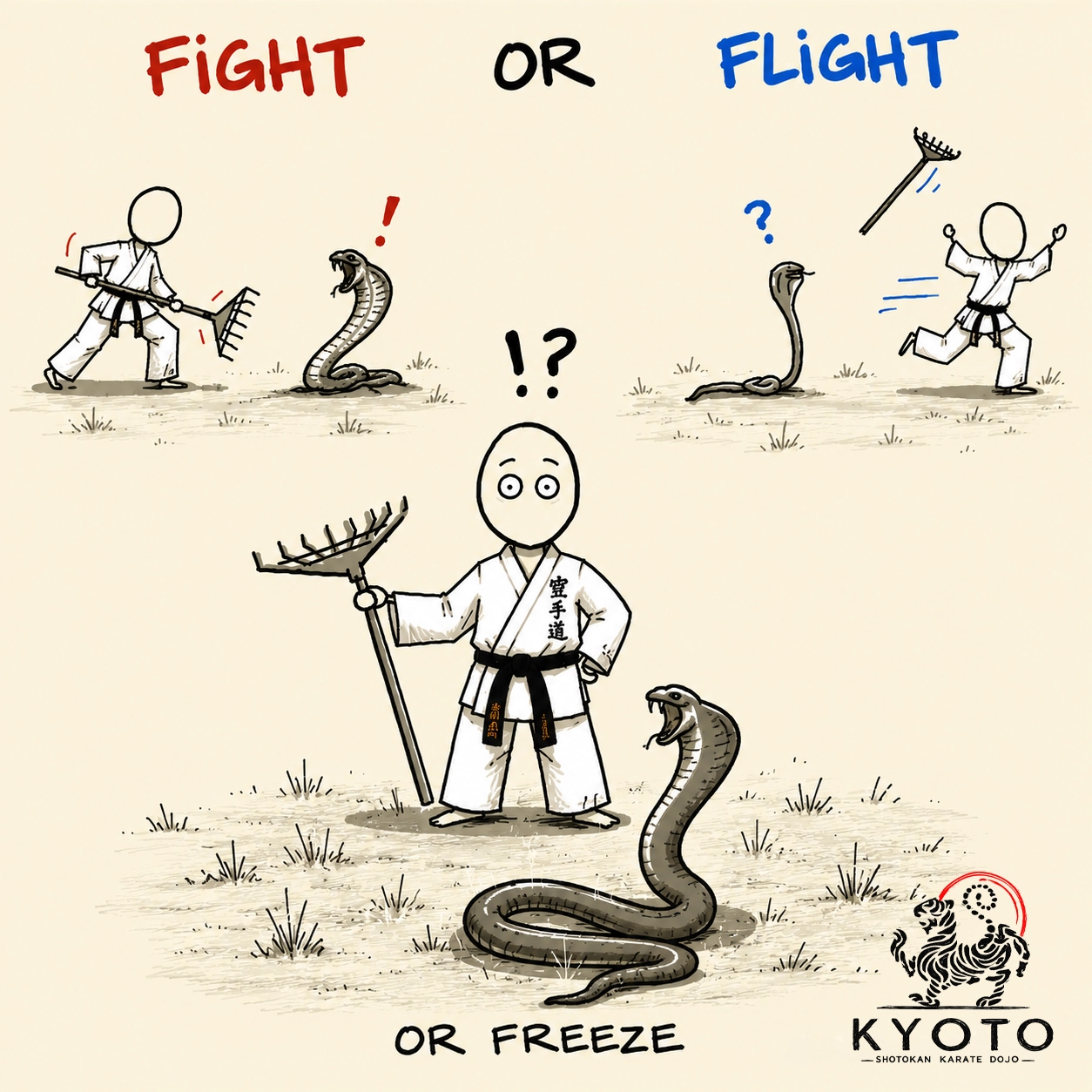 Most people know this as the “fight or flight” response, but modern psychology recognises several common responses to stress:
- Fight
- Flight
- Freeze
- Sometimes, Fawn
Karate training cannot remove these instincts completely. Nor should it. They are deeply rooted survival mechanisms.
What traditional karate attempts to do is help us function through them — developing composure, awareness and emotional control even when the body is under pressure.
At Kyōtō (橋頭), this is one of the hidden lessons beneath kihon, kata and kumite.
Understanding What Happens in the Brain
When a person perceives danger, the brain rapidly shifts into survival mode.
The image above illustrates several important areas involved during this process.
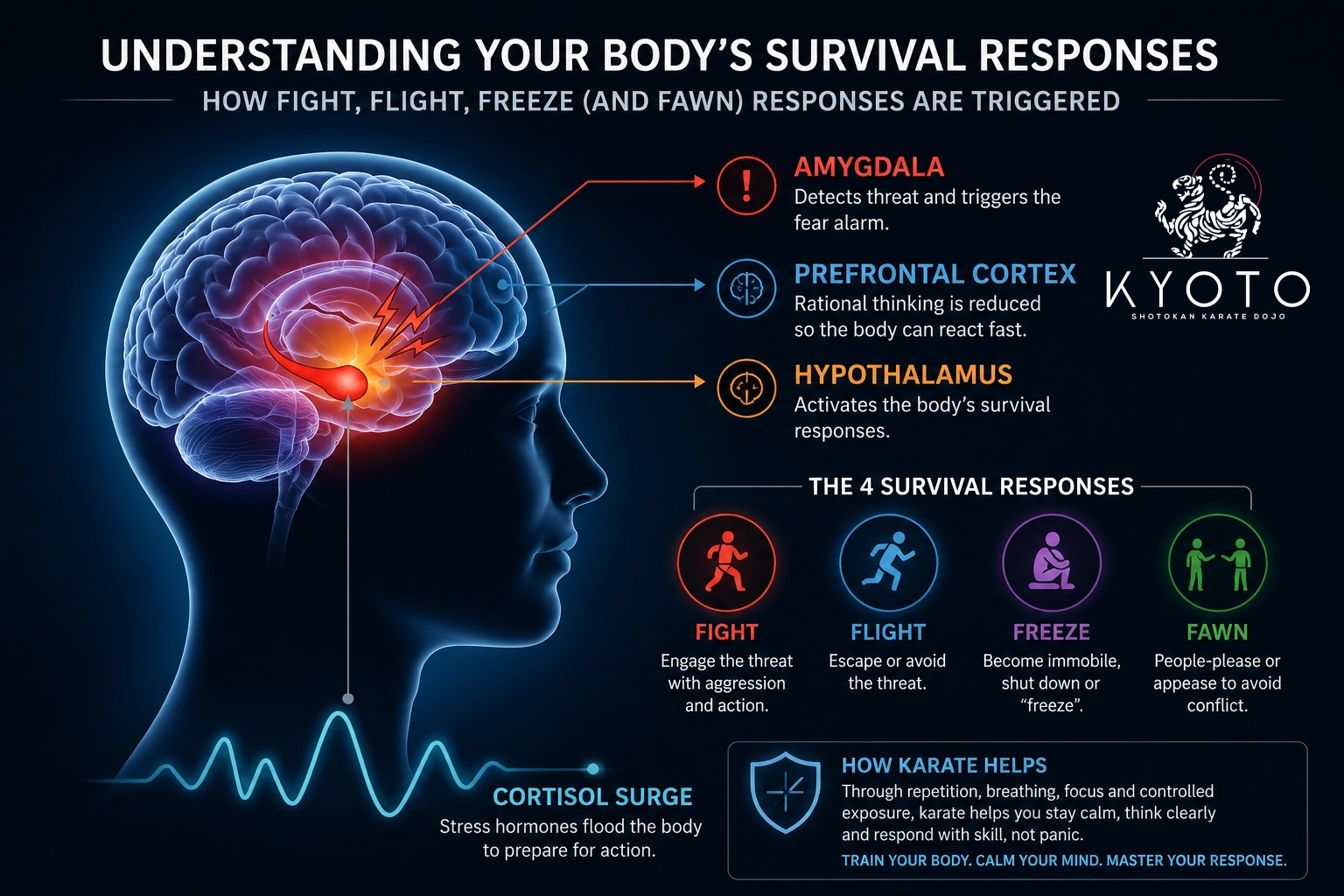
The Amygdala — The Fear Alarm
The amygdala acts almost like an internal alarm system.
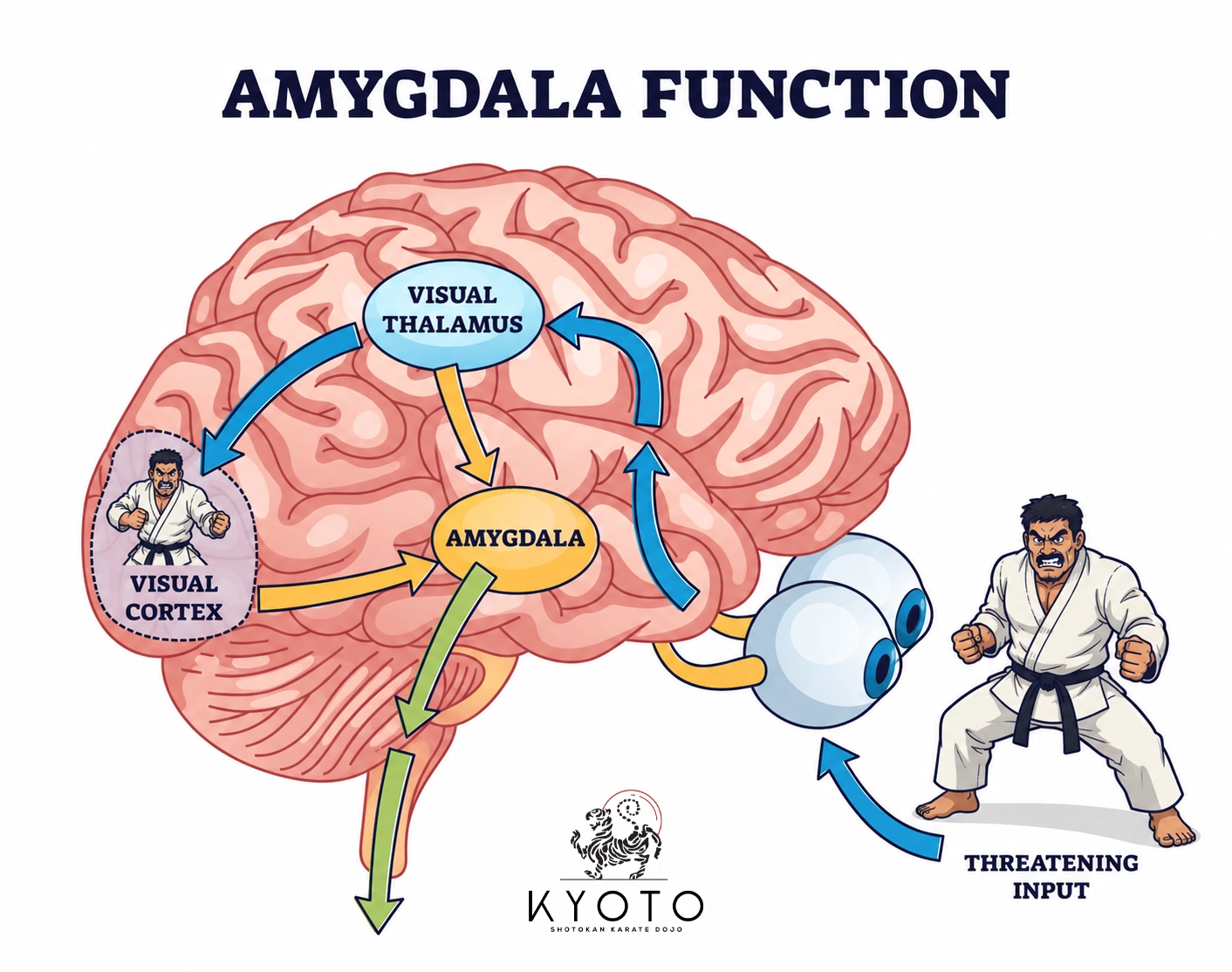 When it detects danger — real or perceived — it immediately signals the body to prepare for survival.
This can happen incredibly quickly:
- an opponent suddenly moving forward,
- an unexpected attack,
- pressure during grading,
- fear of embarrassment,
- confrontation,
- or anxiety in competition.
The amygdala does not carefully analyse whether the threat is truly dangerous.
Its purpose is speed.
This is why people sometimes react emotionally before thinking rationally.
The Hypothalamus — Activating Survival Mode
Once the threat is detected, the hypothalamus helps activate the body’s survival response.
Adrenaline and stress hormones begin flooding the body.
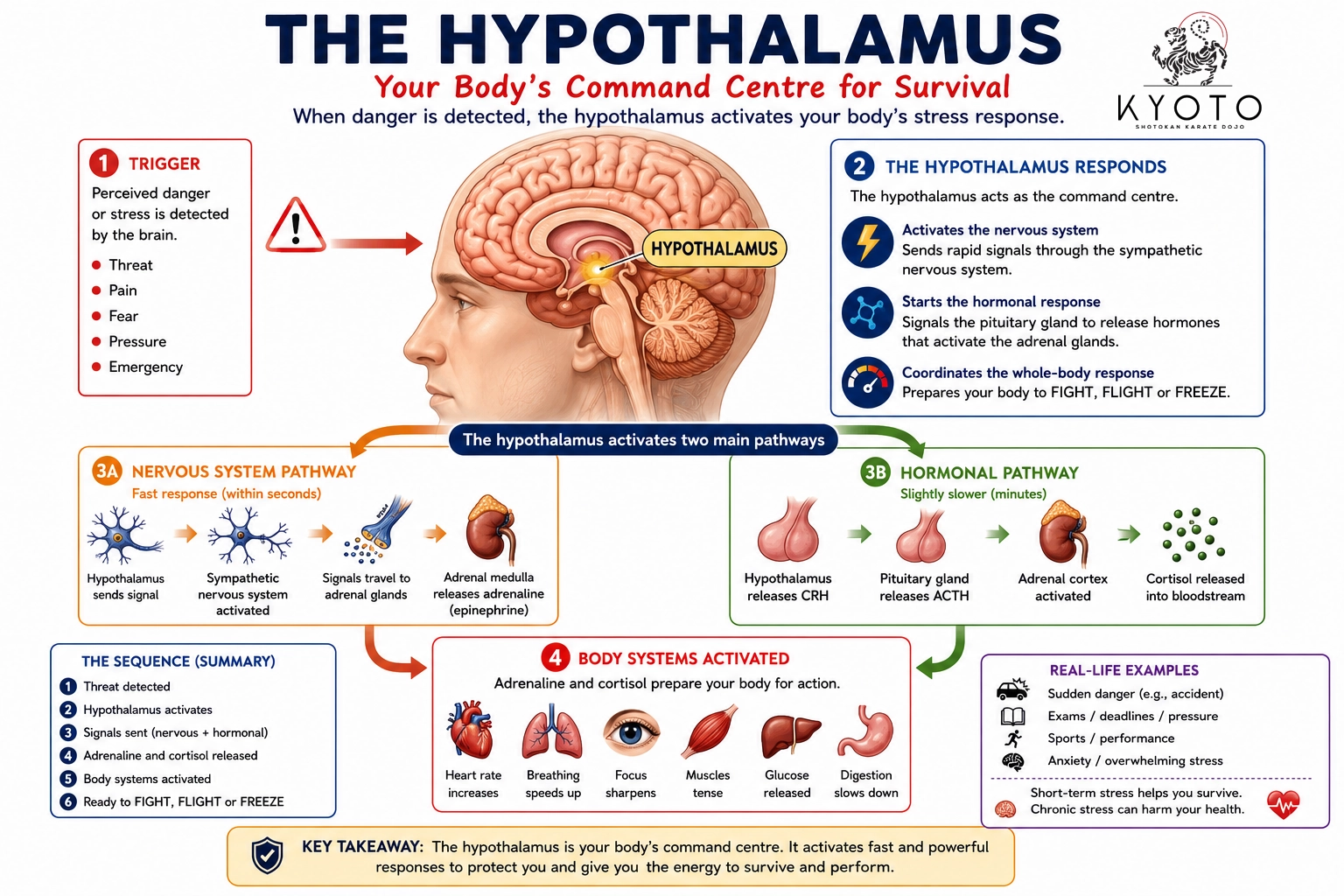 Heart rate increases.
Breathing changes.
Muscles tense.
Awareness narrows.
This prepares the body for:
- fighting,
- escaping,
- or freezing.
In a genuine emergency this response can be lifesaving.
But inside the dōjō, the same biological system may activate even though the environment is controlled and safe.
A white belt facing their first kumite drill may experience genuine panic despite there being no real danger.
The body simply interprets pressure as threat.
The Prefrontal Cortex — Reduced Rational Thinking
During high stress, the brain temporarily reduces activity in the prefrontal cortex.
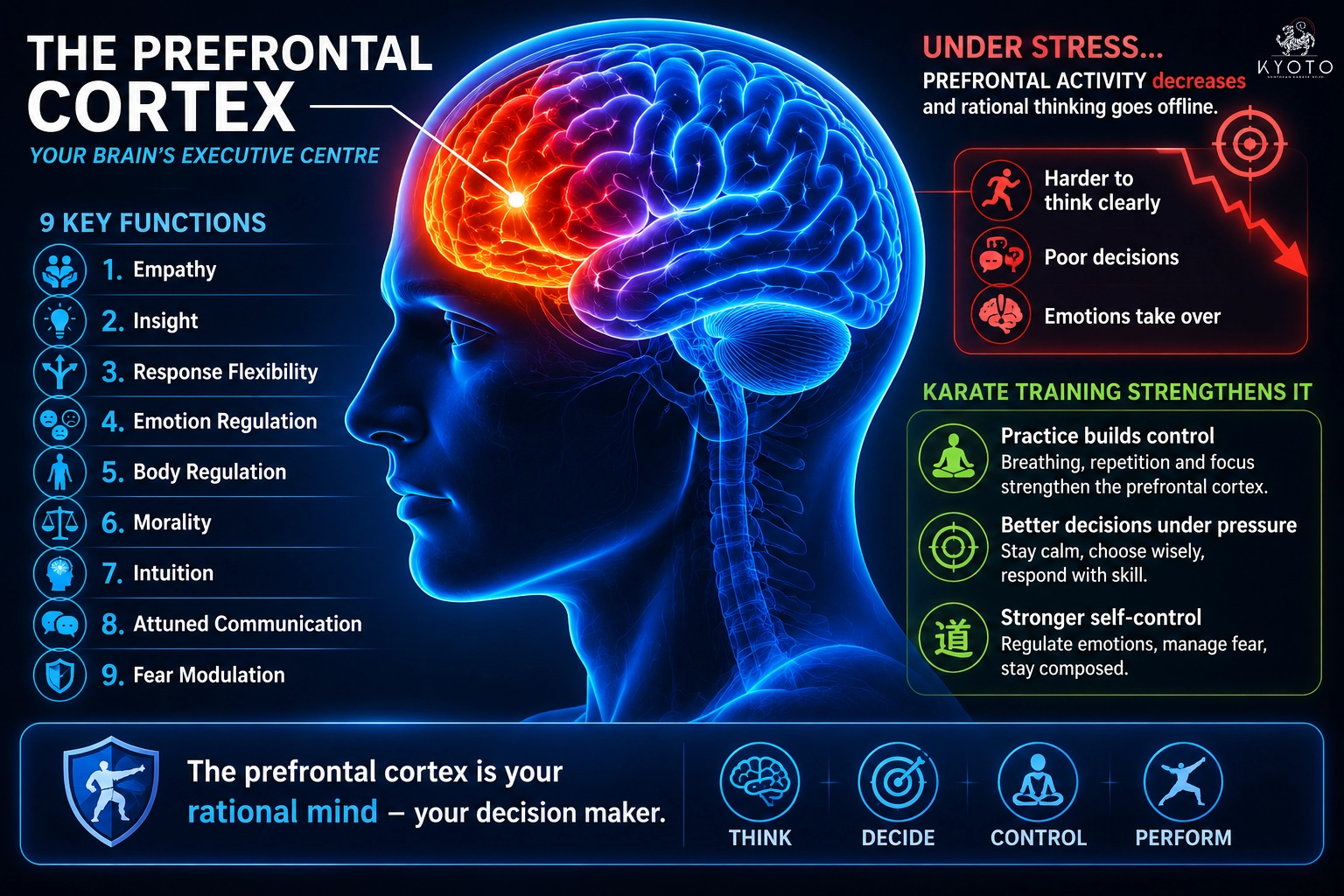 This area is responsible for:
- rational thought,
- decision making,
- analysis,
- and calm processing.
This explains why students sometimes:
- forget combinations,
- panic,
- freeze,
- rush techniques,
- or make mistakes they normally would not make.
Under pressure, the body prioritises survival over precision.
This is entirely normal.
Cortisol and the Physical Response
Stress hormones such as cortisol prepare the body for action.
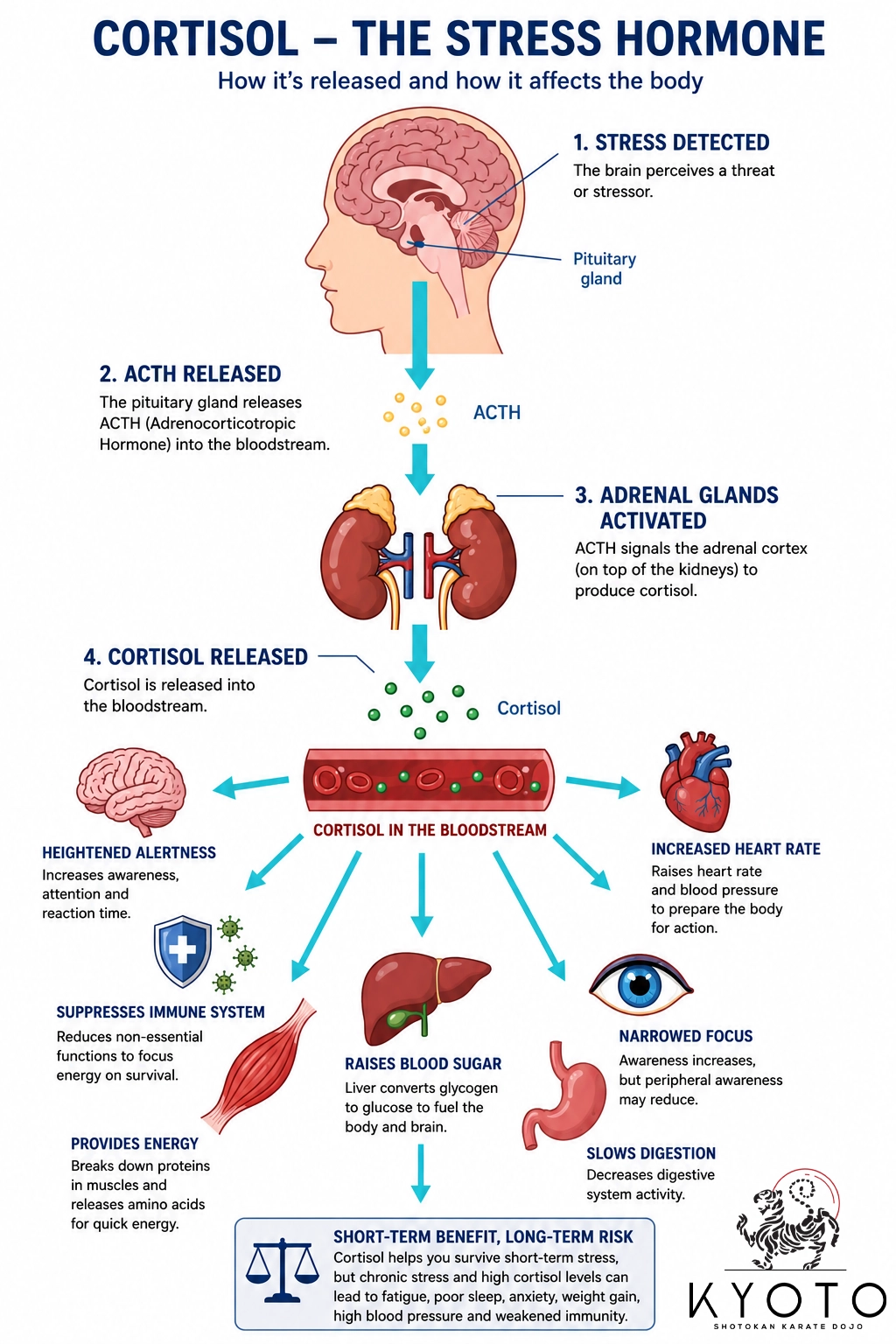 This creates physical sensations many karateka recognise:
- shaky hands,
- rapid heartbeat,
- sweating,
- tunnel vision,
- tension,
- adrenaline surges.
Again, this is not weakness.
It is biology.
Karate training helps students become familiar with these sensations so they do not become overwhelmed by them.
Fight
The “fight” response engages the threat aggressively.
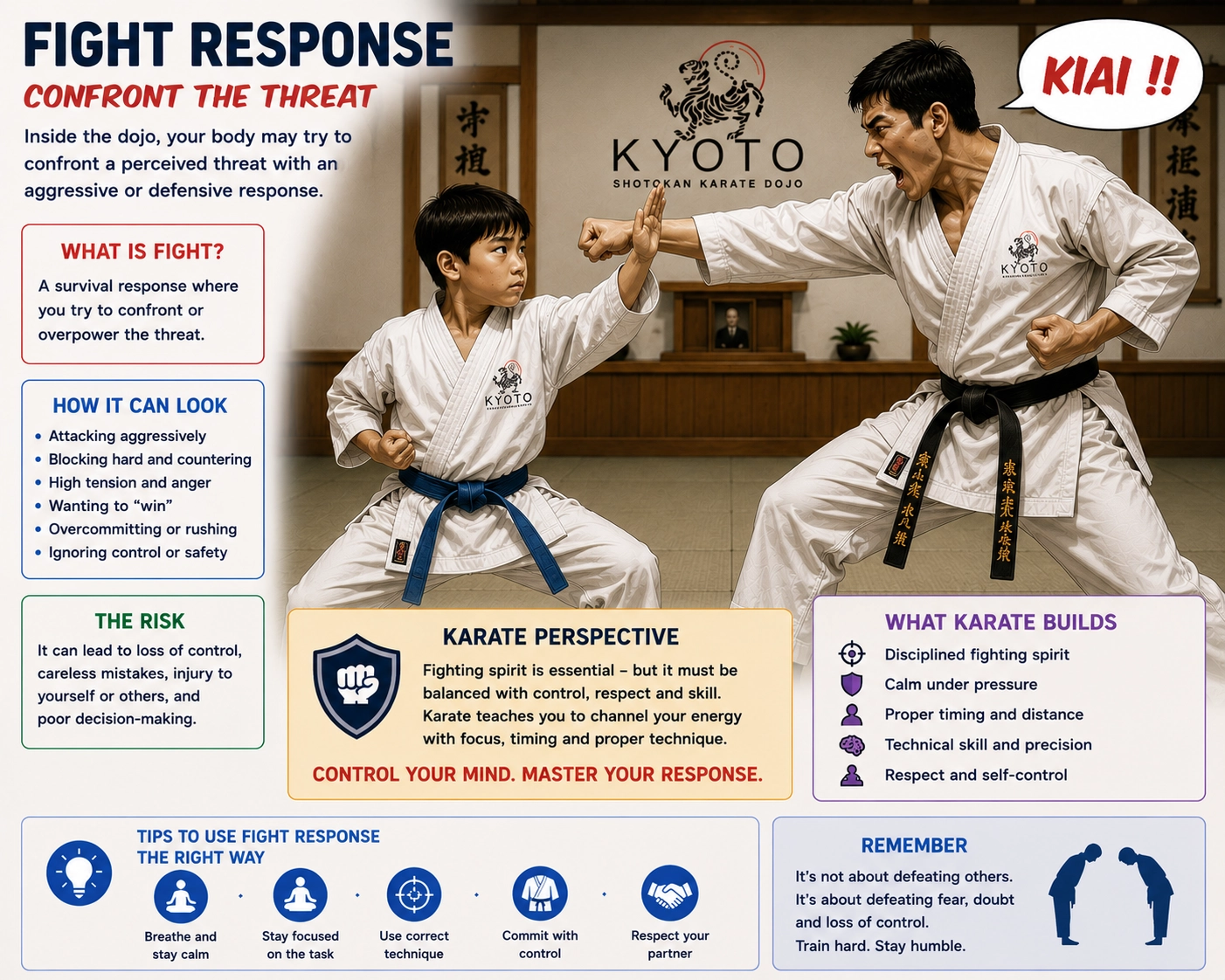 In karate this may appear as:
- rushing forward wildly,
- excessive tension,
- loss of control,
- overcommitting attacks,
- emotional reactions instead of technical ones.
Beginners sometimes confuse aggression with confidence.
But uncontrolled aggression is often fear expressed outwardly.
Traditional karate seeks controlled action:
- controlled timing,
- controlled distance,
- controlled breathing,
- controlled emotion.
Flight
The “flight” response attempts escape.
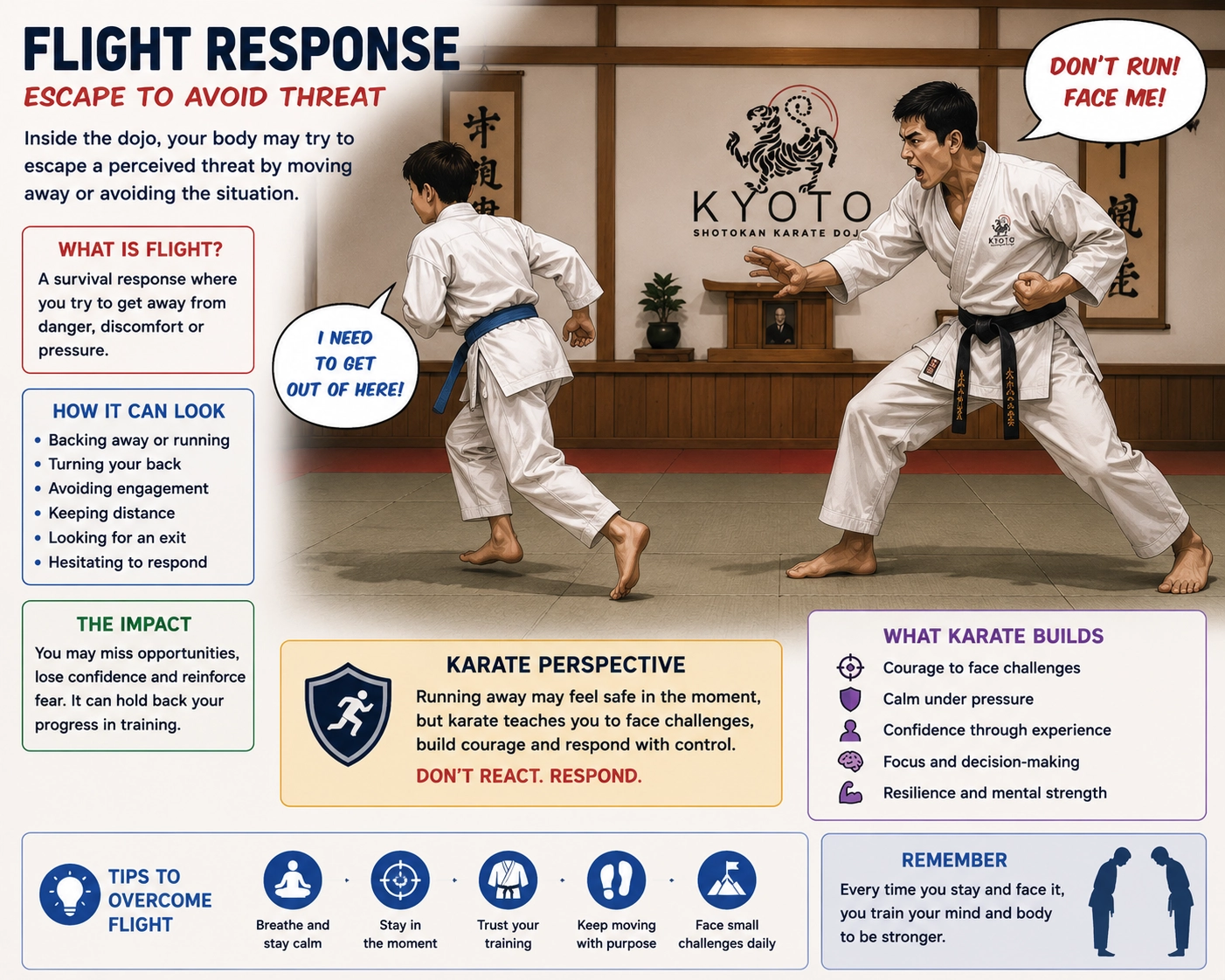 In karate this may appear as:
- avoiding kumite,
- constantly retreating,
- hesitating,
- avoiding gradings or competition,
- or withdrawing mentally under pressure.
Sometimes students are physically capable but emotionally avoid discomfort.
Karate gradually teaches students to remain present despite pressure.
Not through force.
But through controlled exposure and repetition.
Freeze
Freeze is perhaps the most misunderstood response.
Instead of fighting or escaping, the body momentarily locks.
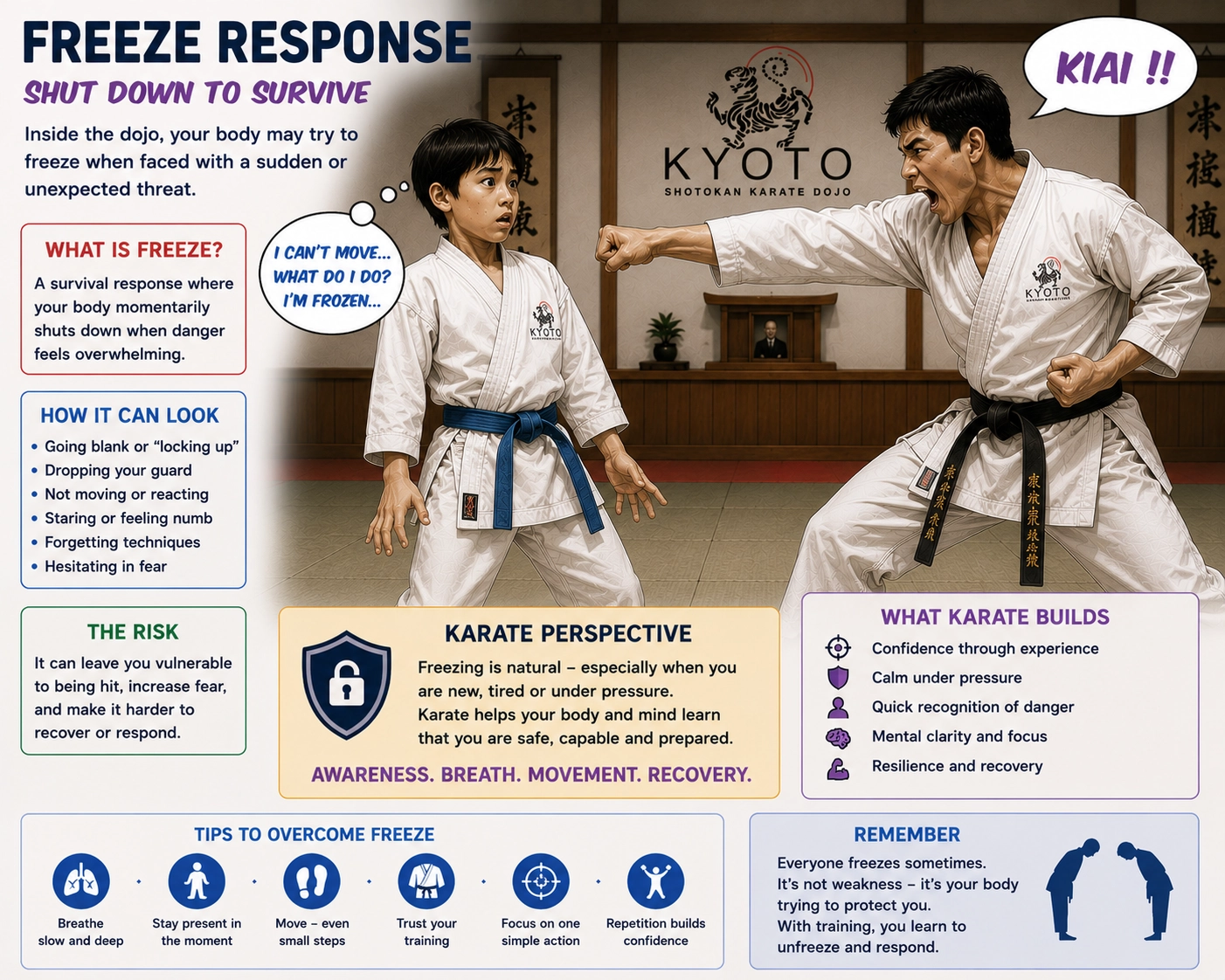 The student:
- stops moving,
- goes blank,
- hesitates,
- forgets combinations,
- or mentally shuts down.
Many karateka experience this in their first experiences of kumite.
A punch suddenly comes toward them and the nervous system overloads momentarily.
Freeze is not cowardice.
Often the brain is trying to avoid making the wrong decision under stress.
Karate training helps reduce this response through familiarity and repetition.
Over time:
- movement becomes conditioned,
- posture stabilises,
- reactions improve,
- confidence grows.
The karateka gradually learns to function despite adrenaline.
What About “Fawn”?
Modern psychology sometimes includes a fourth response:
- Fawn
This involves appeasing others to avoid conflict.
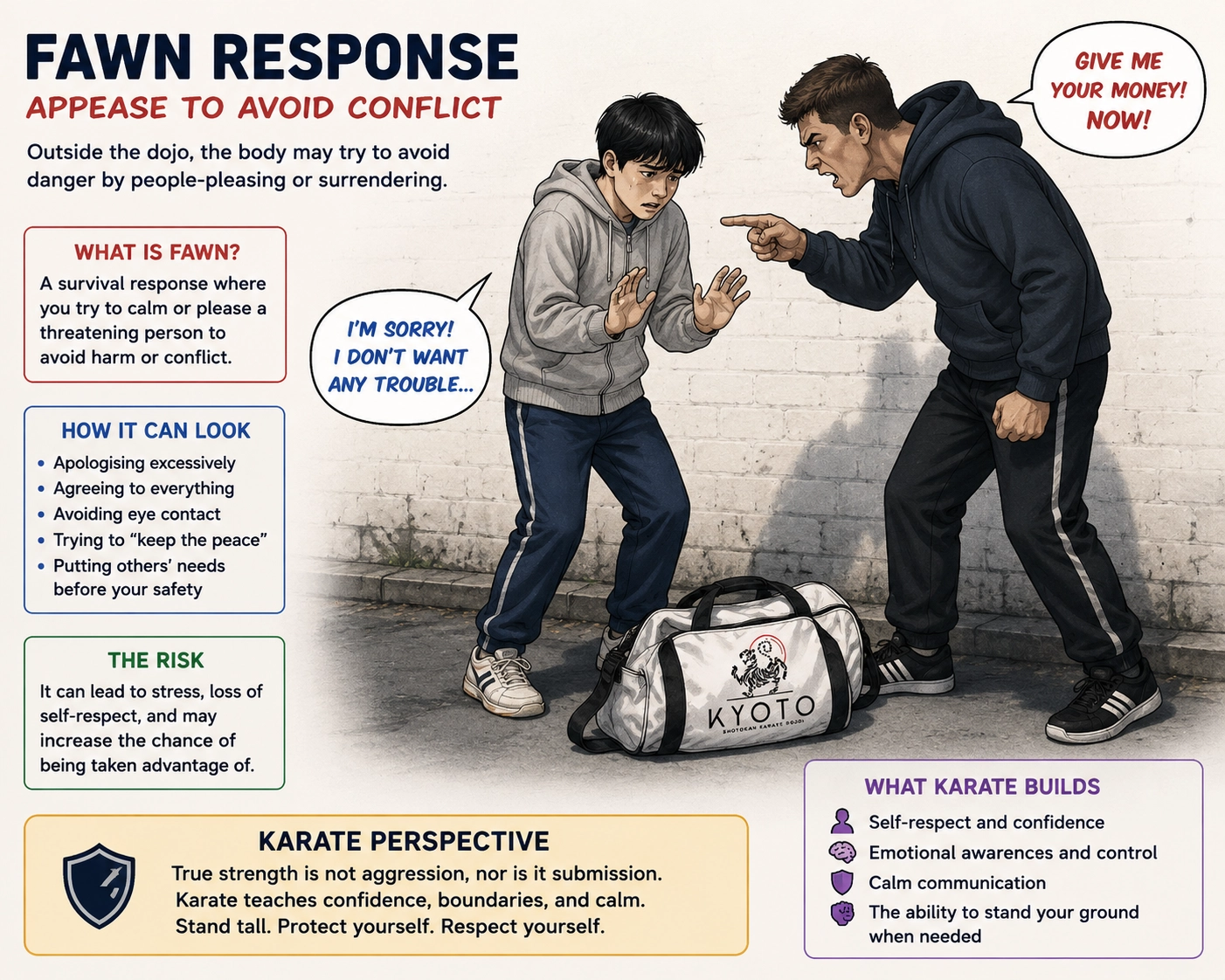 It is less directly applicable within karate kumite itself, but may appear outside the dōjō:
- avoiding confrontation,
- excessive compliance,
- suppressing opinions,
- trying to keep peace at personal cost.
Traditional budō can help here too.
Not by encouraging aggression — but by developing:
- confidence,
- self-respect,
- calm communication,
- and emotional steadiness.
Karate should never create bullies.
But neither should it create people unable to stand their ground when necessary.
Why Karate Uses Repetition
Traditional karate repeats techniques thousands of times:
- oi-zuki,
- age-uke,
- mae-geri,
- tai sabaki,
- stepping,
- breathing.
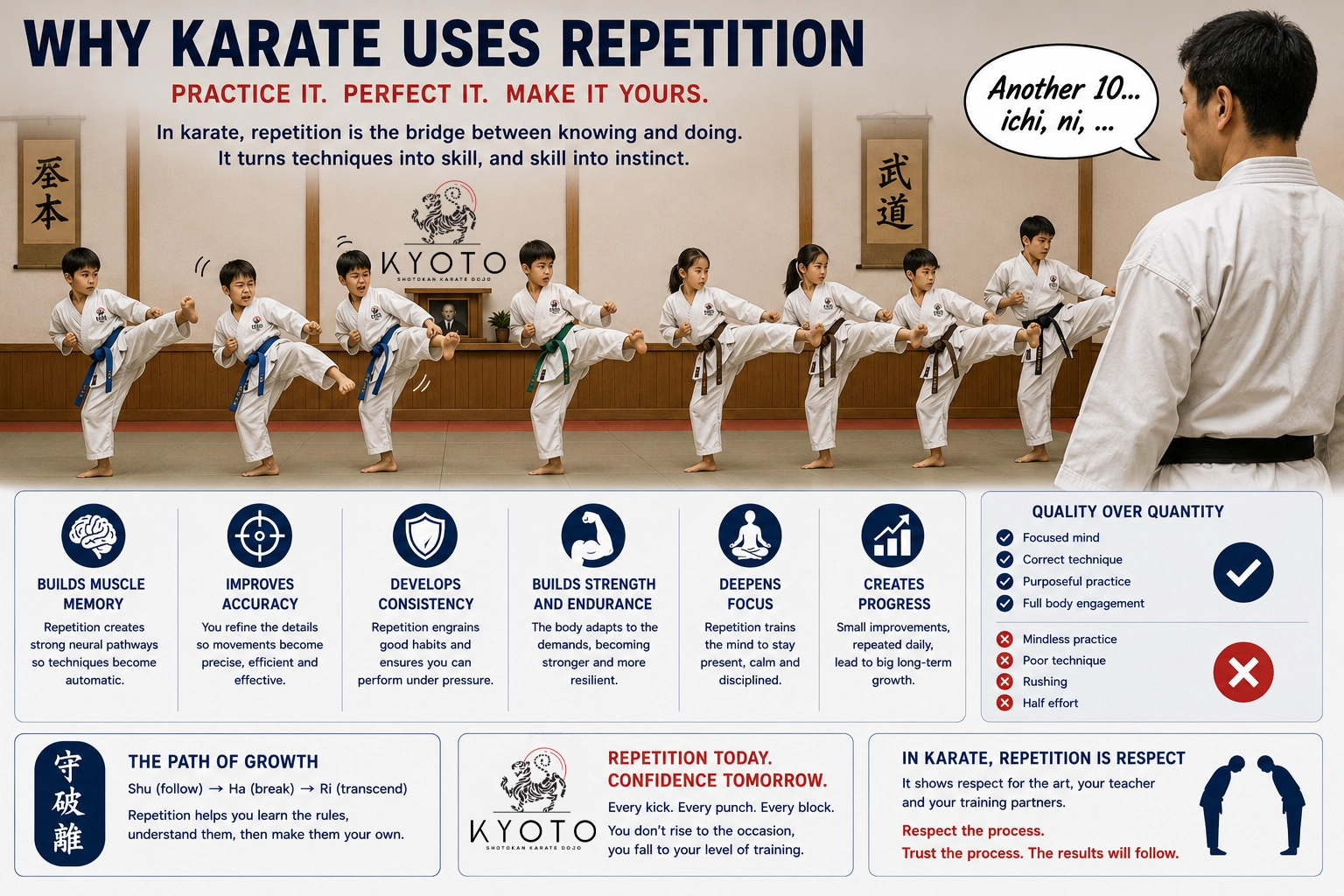 To outsiders this may seem repetitive.
But repetition is not only for memorisation.
It conditions the nervous system.
Under pressure, humans rarely rise to the occasion.
Instead, they fall back onto their level of training.
This is why basics matter.
Through repetition, movement gradually transitions from:
- conscious thought,
- to conditioned response.
The body learns to function despite stress.
Controlled Exposure to Pressure
Karate training gradually introduces stress in manageable amounts.
A beginner may begin with:
- line work,
- basic partner drills,
- structured kumite.
Later comes:
- unpredictability,
- faster attacks,
- grading pressure,
- competition,
- emotional stress.
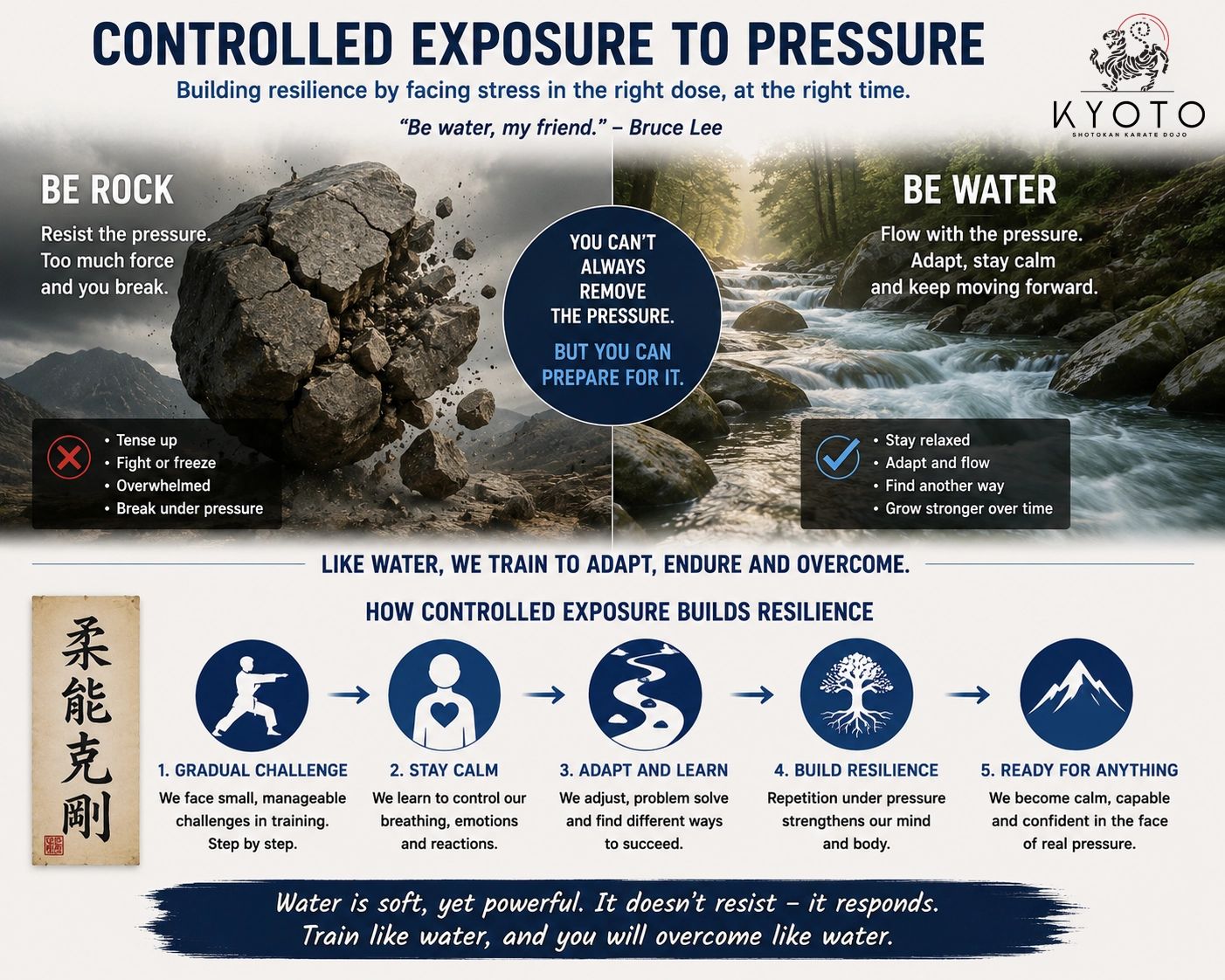 Too little pressure and adaptation never occurs.
Too much pressure and students simply panic.
Good instruction carefully bridges the gap between comfort and challenge.
This is one reason traditional systems remain valuable. The progression is designed not merely to teach technique, but emotional regulation.
Breathing and Emotional Control
One of the first casualties of fear is breathing.
People unconsciously:
- hold their breath,
- tighten shoulders,
- clench the jaw,
- lose rhythm.
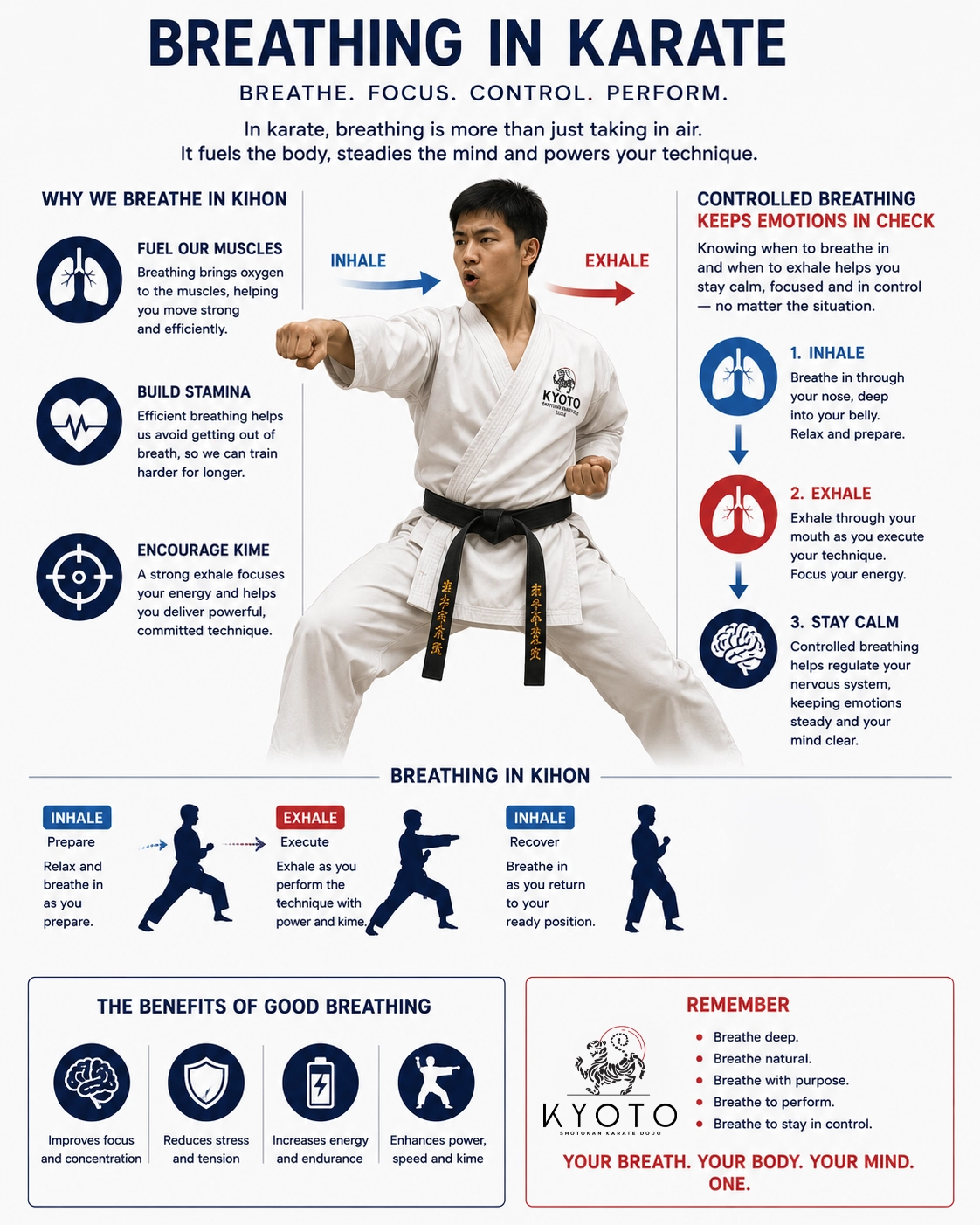 Karate constantly returns students to breathing:
- exhalation on technique,
- kiai,
- mokusō,
- posture,
- controlled rhythm.
Breathing acts like a bridge between mind and body.
A calm breath can reduce panic signals throughout the nervous system.
This is why experienced karateka often appear composed under pressure.
It is not absence of fear.
It is management of fear.
柔能克剛 — Softness Overcomes Hardness
The strongest karateka is not necessarily the most forceful. Like water flowing around a rock, true resilience comes from adaptation rather than resistance.
Mushin — The Empty Mind
In Japanese budō there is the concept of mushin (無心), often translated as “empty mind.”
This does not mean thoughtlessness.
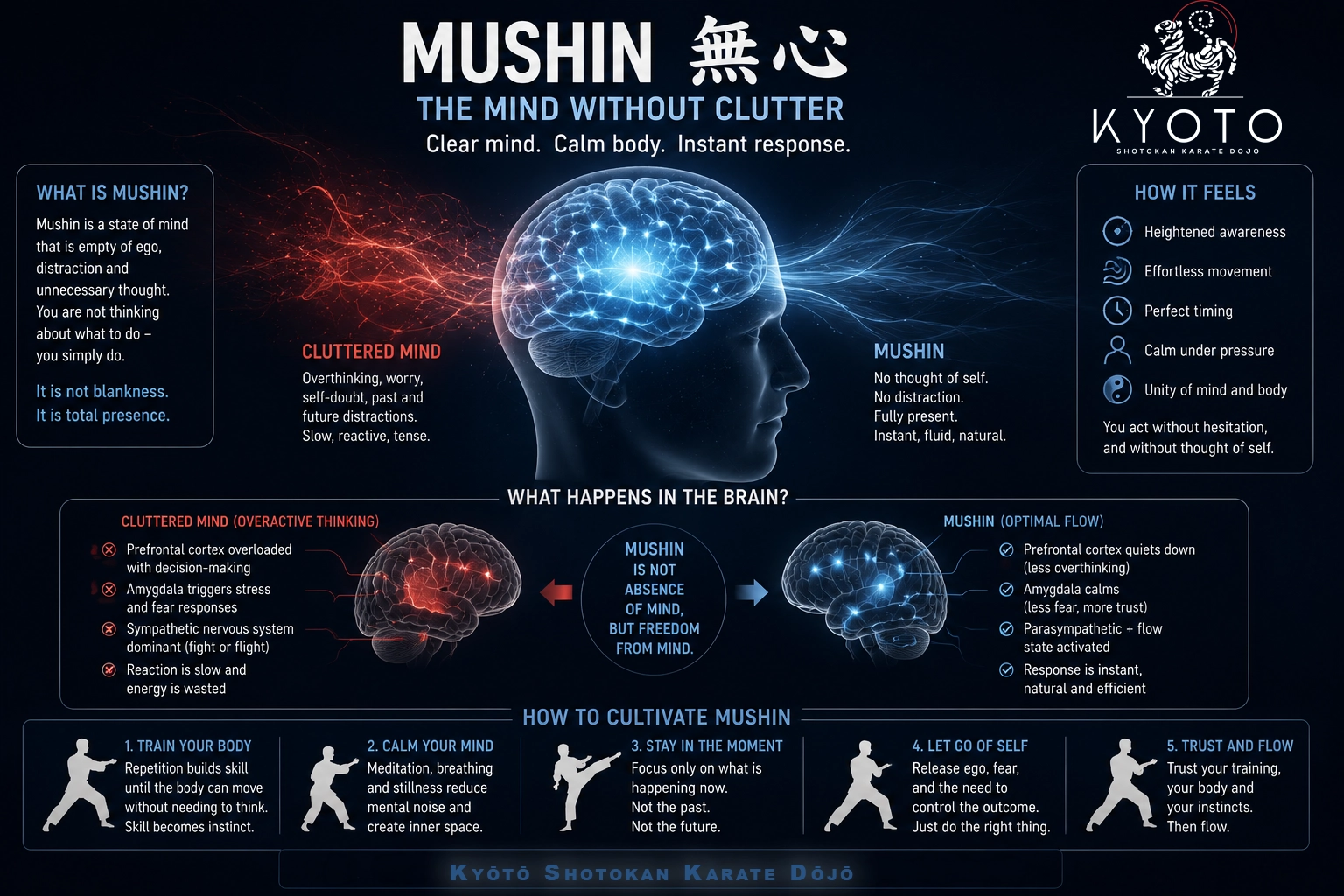 It means freedom from paralysis caused by:
- fear,
- hesitation,
- ego,
- overthinking.
When the brain enters survival mode, thoughts often become chaotic:
- “What if I fail?”
- “What if I get hit?”
- “What if everyone is watching?”
- “What technique should I do?”
Mushin allows action without panic.
This state cannot simply be switched on.
It develops through years of training.
Beyond the Dōjō
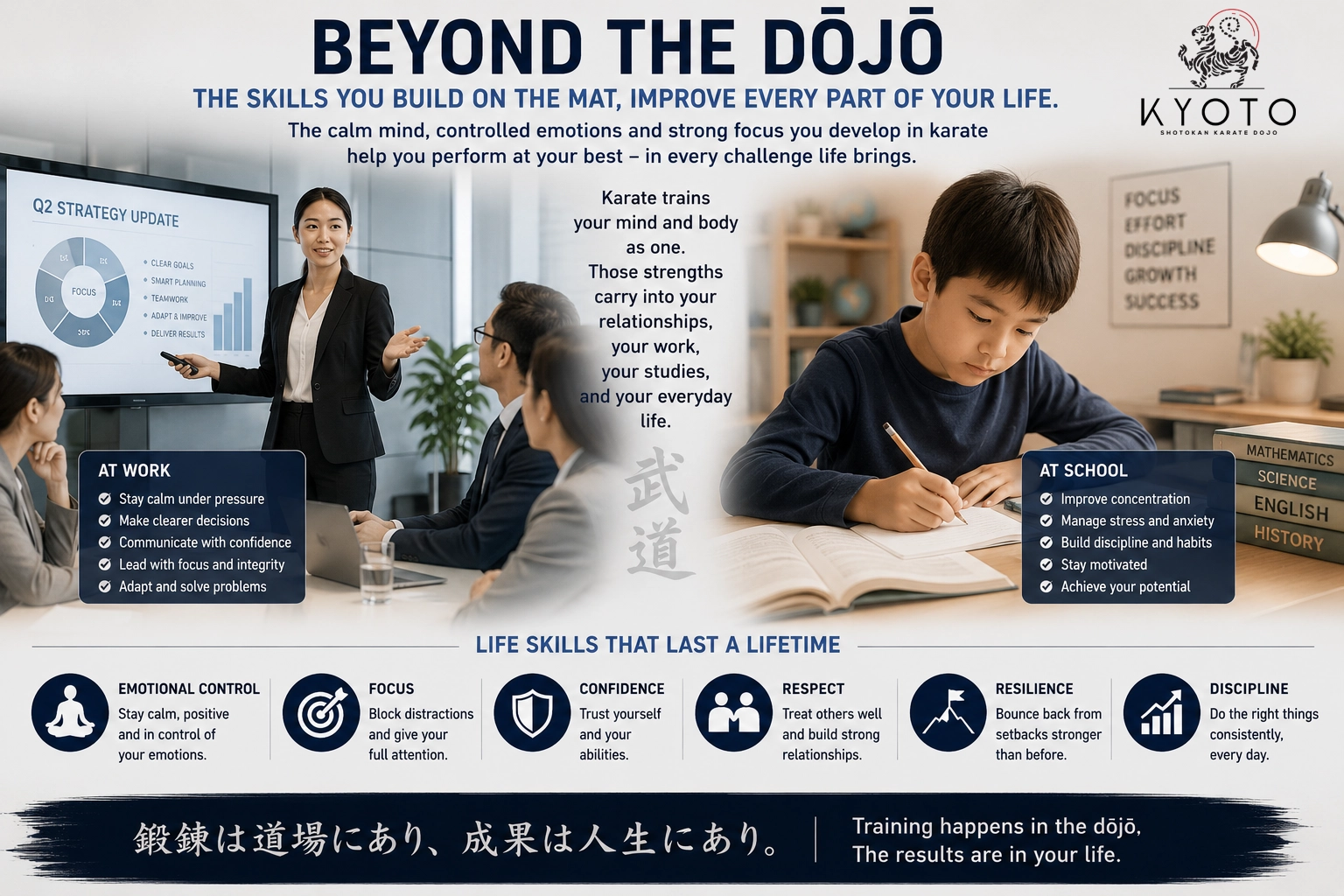 Karate training affects far more than self-defence.
Students often notice improvements in:
- confidence,
- emotional regulation,
- public speaking,
- resilience,
- stress management,
- handling pressure,
- and difficult life situations.
The true purpose of traditional karate was never merely fighting others.
Much of budō is learning to manage oneself.
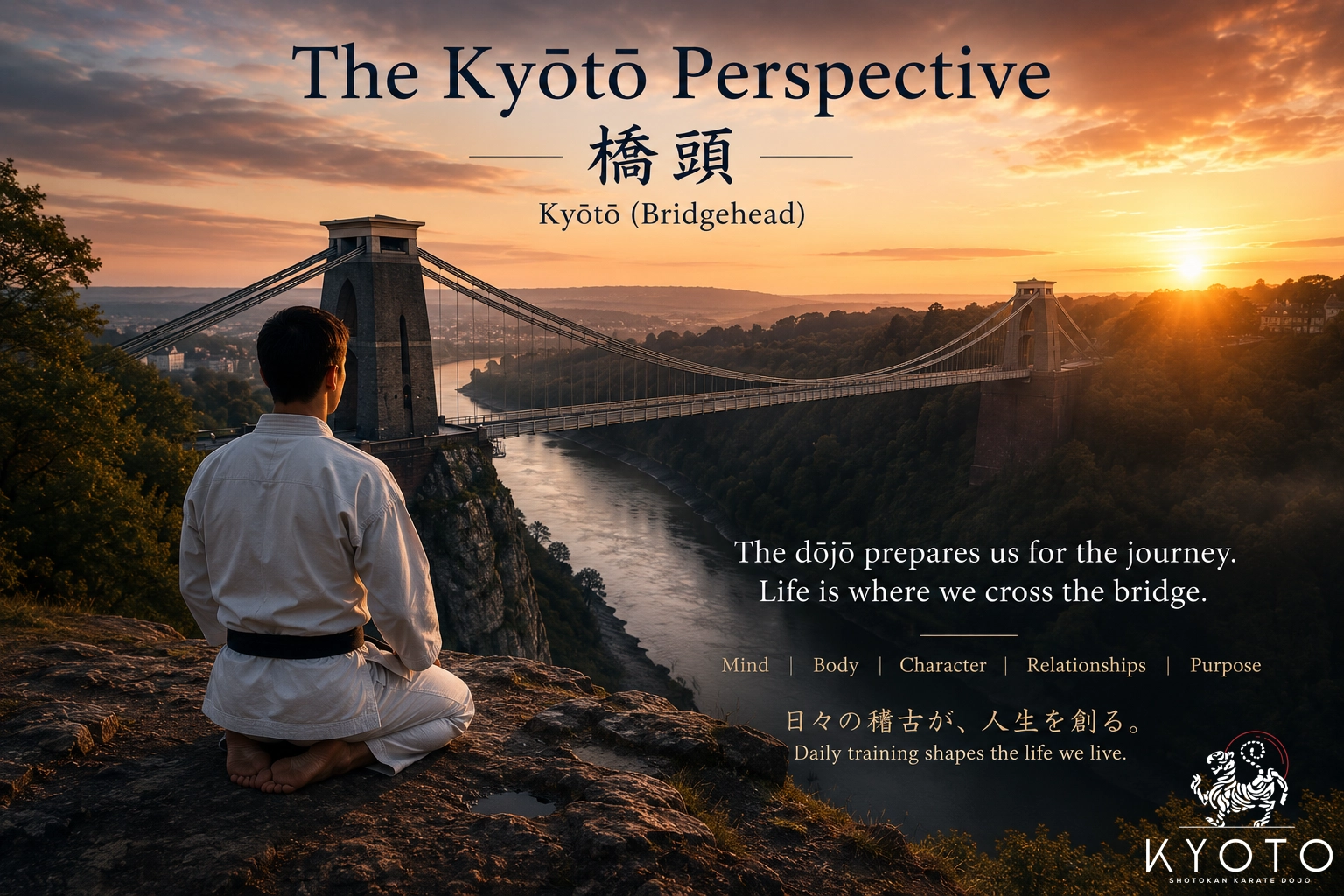
The Kyōtō (橋頭) Perspective
At Kyōtō, students are not expected to be fearless.
They are expected to continue stepping forward despite uncertainty.
Every karateka experiences moments where instinct says:
- fight recklessly,
- run away,
- freeze,
- avoid discomfort.
Training teaches students to recognise these reactions without being controlled by them.
A white belt performing first kumite drills.
A child overcoming anxiety.
An adult returning after years away.
A senior taking a Dan grading.
 These are all forms of learning to function under pressure.
Not through aggression.
But through:
- discipline,
- repetition,
- composure,
- awareness,
- and perseverance.
In many ways, this is one of the deepest lessons within karate-dō.
To remain calm when pressure rises.
To continue functioning when others panic.
And to develop a spirit that does not collapse simply because life becomes difficult.
That is budō.